

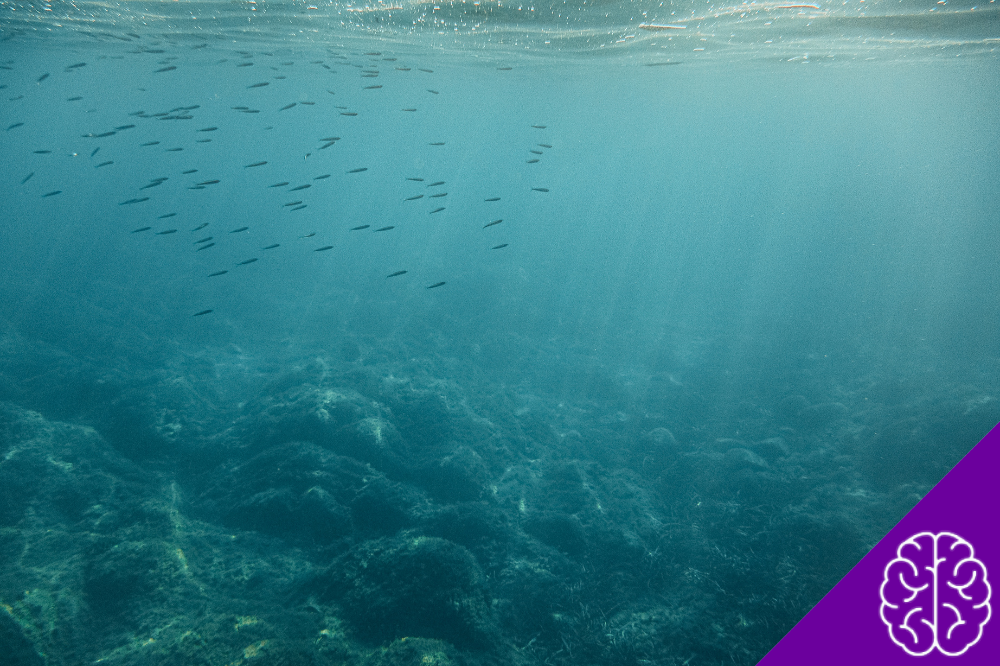
The ocean covers more than 70% of our planet, yet over 80% of it remains unexplored. Scientists have found deep in the ocean a world of mystery, darkness, and immense pressure. Every time a remotely operated vehicle (ROV) descends into the abyss, it has the chance to reveal something that challenges our understanding of life and history.
These expeditions bring back images and data of things so bizarre they seem to belong in science fiction. From otherworldly creatures to lost historical relics and strange geological formations, the discoveries are a constant reminder of how much is still left to learn about our own world. Here are five of the strangest things scientists have uncovered from the planet’s dark, watery depths.
1. The Mysterious Golden Orb Scientists Found Deep in the Ocean
In the fall of 2023, a team from the National Oceanic and Atmospheric Administration (NOAA) was mapping the seafloor off the coast of Alaska. During the Seascape Alaska 5 expedition, their ROV stumbled upon something truly peculiar. More than two miles below the surface, clinging to a rock, was a smooth, golden, dome-shaped object about four inches wide.
Researchers, watching live from the surface, were baffled. It had a soft, skin-like texture and a small hole near its base, suggesting something may have emerged from or entered it. The team decided they had to bring it to the surface for analysis. Using the ROV’s suction arm, they carefully collected the specimen.
Initial theories from scientists aboard the research vessel included:
- An unknown type of egg sac
- A new species of sea sponge
- The remnant of a coral
The mystery of what scientists found deep in the ocean on that day is still being unraveled. DNA analysis is underway to determine its origin. This “golden orb” or “golden egg” captured public imagination, highlighting the fact that brand-new discoveries—some of which are completely unclassifiable at first—are waiting in the unexplored corners of the deep sea.
2. A Ghostly “Forest of the Weird”
Imagine descending to a volcanic mountain deep beneath the Pacific’s surface and finding a landscape that looks like it was designed by an alien artist. That is exactly what a NOAA expedition discovered in an area near the Mariana Trench. They called it the “forest of the weird.”
This underwater ecosystem was populated by bizarre-looking glass sponges and oddly shaped corals. The creatures here have adapted to a world with no sunlight, crushing pressure, and freezing temperatures. The most notable resident of this forest was a glass sponge perched on a long, thin stalk with two holes near its top that resembled large eyes.
Its uncanny similarity to a classic movie alien earned it the nickname the “E.T. Sponge.” Its scientific name, Advhena magnifica, even translates to “magnificent alien.” This creature has only ever been seen in one other location, making it an incredibly rare find. This discovery proves that the deep sea is home to entire ecosystems populated by creatures we are only just beginning to identify.
3. Perfectly Formed Underwater Crop Circles
For years, divers off the coast of Japan were puzzled by ornate, geometric circles appearing on the sandy seafloor. These intricate patterns, nearly seven feet in diameter, resembled the mysterious crop circles sometimes found in farmers’ fields. The origin of these “underwater crop circles” remained a mystery for over a decade.
Finally, in 2011, scientists solved the puzzle. The artist responsible was not an extraterrestrial, but a tiny male pufferfish. Researchers discovered that the male fish works tirelessly, flapping its fins 24 hours a day for over a week, to carve these elaborate circular nests in the sand.
The ridges and valleys of the circle are not just for show. They are engineered to channel fine sediment toward the center, creating a soft, protective bed. Female pufferfish are drawn to the most complex and well-constructed nests to lay their eggs. The male then fertilizes the eggs and guards them. This remarkable behavior, found deep in the ocean’s coastal regions, demonstrates a level of artistry and engineering in the animal kingdom that was previously unknown.
4. The Yonaguni Monument: Natural or Man-Made?
Near the Japanese island of Yonaguni lies one of the most controversial items ever found deep in the ocean. Discovered by a diver in the mid-1980s, the Yonaguni Monument is a massive underwater rock formation with stunningly geometric features. It consists of huge, terraced blocks of sandstone with flat sides, sharp angles, and what appear to be carved steps.
The main structure is over 165 feet long and 65 feet wide, leading some to believe it is the remnant of an ancient city that was submerged by a seismic event. Proponents of this theory suggest it could be evidence of a lost Pacific civilization dating back 5,000 years or more. They point to formations that resemble walls, a “stage,” and even a turtle-shaped carving.
However, many geologists remain skeptical. They argue that the monument’s features can be explained by natural geological processes. Sandstone tends to break along straight planes, and the region’s strong currents and tectonic activity could have eroded the rock into its current geometric shape over thousands of years. Whether it is a natural wonder or a lost piece of human history, the Yonaguni Monument remains a captivating deep-sea enigma.
5. An Underwater River in the Gulf of Mexico
One of the most surreal things scientists found deep in the ocean is a river that flows along the seafloor. Located in the Gulf of Mexico, this phenomenon is not an optical illusion. It is a real, flowing body of water with its own banks, ripples, and even waterfalls.
This underwater river is formed by a process called a “brine pool.” The water in this area is significantly saltier—and therefore denser—than the surrounding seawater. This dense, salty water settles in depressions on the ocean floor, creating a distinct pool with a visible surface. Seawater from the Gulf cannot easily mix with it, so it flows along the bottom like a river on land.
The brine is extremely toxic to most marine life. Any fish or crab that accidentally swims into the “river” is immediately killed and preserved by the high salt concentration. However, certain types of mussels and bacteria have adapted to thrive along the river’s banks, feeding on the chemicals that seep from the ocean floor. This strange and deadly environment provides a glimpse into how life might exist on other planets under extreme conditions.
The Endless Mystery of What’s Found Deep in the Ocean
The deep ocean continues to be a frontier of discovery. Each strange thing scientists have found deep in the ocean—from golden orbs and alien-like sponges to geometric monuments and underwater rivers—serves as a testament to the vast mysteries that remain beneath the waves.
As technology advances and exploration pushes further, we can only imagine what incredible, bizarre, or enlightening discoveries still await us in these dark, largely uncharted realms. The wonders scientists have already found are just the beginning—there is an entire world deep in the ocean left to explore.