

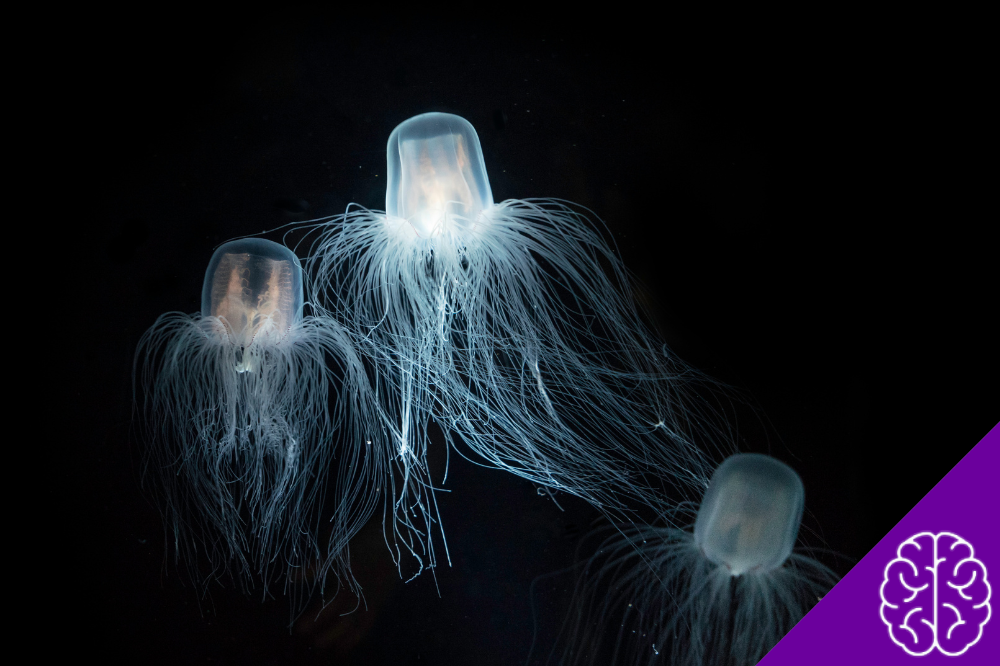
The quest for eternal life has been a staple of human mythology for millennia, yet the answer might have been floating in our oceans all along. Known scientifically as Turritopsis dohrnii, the immortal jellyfish has captivated the global scientific community with its ability to cheat death. Unlike any other known complex organism, this tiny creature possesses a biological “reset button” that allows it to revert to its youth when faced with trauma, age, or environmental stress.
While most animals follow a linear path from birth to death, this jellyfish operates on a loop. This unique phenomenon challenges our fundamental understanding of aging and cellular biology. By exploring the mechanics behind this creature’s survival, we gain insight into a process that sounds like science fiction but is a documented reality of marine biology.
The Biological “Time Travel” Mechanism
The secret to the immortal jellyfish lies in a rare cellular process called transdifferentiation. When the jellyfish reaches its adult stage (the medusa) and encounters physical damage or starvation, it does not simply die. Instead, it transforms its existing cells into different types of cells, effectively turning its body back into a blob-like cyst.
This cyst eventually develops into a polyp colony, which is the earliest stage of the jellyfish life cycle. From this colony, new, genetically identical medusae are birthed. This cycle can theoretically repeat indefinitely, allowing the organism to bypass the traditional end of life. Scientists are particularly interested in this because it involves:
- Cellular Reprogramming: Converting specialized adult cells back into stem-cell-like states.
- Life Cycle Reversal: Moving backward from a mature adult to an immature juvenile.
- Genetic Preservation: The “reborn” jellyfish is a perfect genetic clone of the original.
A Life Cycle Unlike Any Other
To appreciate the strangeness of Turritopsis dohrnii, one must understand the typical jellyfish life cycle. Most species follow a strict progression that ends once the adult medusa reproduces and eventually decays. The immortal jellyfish, however, treats the adult stage as a flexible phase rather than a final destination.
- Planula: The life cycle begins as a tiny larva swimming in the open ocean.
- Polyp: The larva settles on the sea floor, growing into a stationary colony.
- Medusa: The colony buds off free-swimming jellyfish (the form we recognize).
- The Reversion: Instead of dying after spawning, Turritopsis dohrnii can return to the polyp stage.
This reversal is often triggered by environmental crises. If the water temperature drops significantly or food becomes scarce, the jellyfish “de-ages” rather than succumbing to harsh conditions. This adaptation makes it an incredibly resilient survivor in changing marine ecosystems.
Can It Actually Die?
Despite its name, the immortal jellyfish is not invincible. The term “immortal” refers specifically to biological immortality, meaning it does not die of old age or natural cellular decay. In the wild, however, these creatures still face numerous threats capable of ending their lives permanently.
Because they are extremely small—roughly the size of a pinky nail—they become easy prey for many marine predators. In addition, the process of transdifferentiation requires time and relatively stable conditions. If something destroys the jellyfish before the transformation completes, the cycle ends.
- Predation: Fish, sea turtles, and larger jellyfish frequently consume them.
- Disease: Like all organisms, they remain vulnerable to infections.
- Physical Trauma: Severe damage can destroy the cellular structure beyond repair.
The Global “Invasion” of a Tiny Hitchhiker
Scientists first identified the immortal jellyfish in the Mediterranean Sea during the late nineteenth century. Today, researchers have documented populations across oceans around the world, including coastal regions near Japan, Panama, and Spain. Human activity plays a major role in this expansion.
These jellyfish often travel unnoticed inside the ballast tanks of cargo ships. When ships release water in different ports, they unintentionally introduce the species into new ecosystems. The jellyfish survives these long journeys because its ability to revert into the polyp stage increases its resilience during stressful conditions.
What Humans Can Learn from This Creature
The study of Turritopsis dohrnii extends far beyond scientific curiosity. Researchers continue investigating its cellular mechanisms to better understand tissue regeneration, aging, and disease prevention in humans.
If scientists can identify the molecular instructions responsible for cellular “resetting,” future medicine could potentially improve regenerative therapies and organ repair. Current areas of research include:
- Telomere Maintenance: Understanding how the jellyfish restores protective DNA structures during reversion.
- Stem Cell Research: Applying lessons from the jellyfish to improve stem cell manipulation.
- Cancer Studies: Studying how cellular transformation occurs without uncontrolled growth.
The Endless Loop of Nature
The immortal jellyfish serves as a reminder that nature still holds biological mysteries capable of reshaping modern science. While humans experience life as a progression toward aging and death, this tiny marine organism follows a repeating cycle that challenges traditional assumptions about mortality.
Although Turritopsis dohrnii is not truly invulnerable, its ability to repeatedly reset its life cycle remains one of the most extraordinary discoveries in evolutionary biology. As researchers continue exploring the microscopic world of the oceans, this remarkable species may help unlock entirely new understandings of aging, regeneration, and survival.