

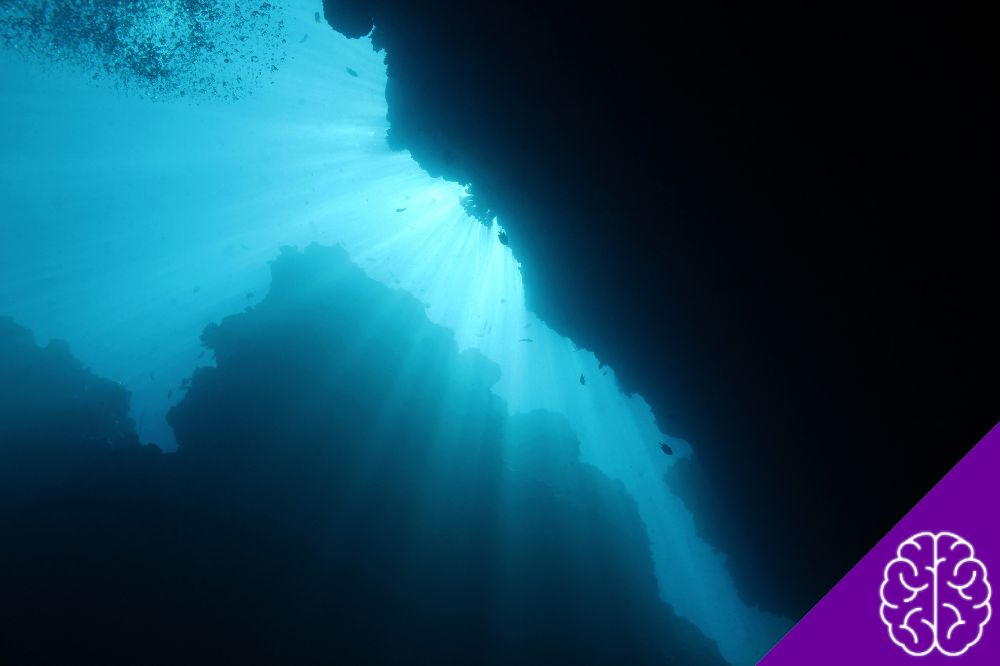
The deep ocean is one of the least explored places on Earth. Sunlight disappears, temperatures stay close to freezing, and the pressure becomes intense enough to crush most surface-dwelling animals.
To survive in this environment, many deep sea creatures have evolved unusual features that seem almost extraterrestrial. Transparent heads, glowing bodies, oversized jaws, and long tentacles may look like science fiction, but they are all real adaptations that help these animals hunt, hide, or communicate in complete darkness.
Here are eight of the most fascinating deep-sea animals scientists have discovered.
1. Barreleye fish
The barreleye fish is famous for its transparent, dome-shaped head.
Inside that clear shield are its tubular eyes, which can rotate to look upward for prey or forward while feeding. This remarkable adaptation helps the fish detect tiny silhouettes against the faint light filtering down from the surface.
For decades, scientists believed its eyes pointed only upward. More recent observations revealed they can also rotate, giving the fish a much wider field of vision.
2. Black seadevil anglerfish
The black seadevil anglerfish is one of the best-known deep sea creatures, largely because of the glowing lure that extends from its head.
This bioluminescent appendage attracts curious prey close enough for the fish to strike with its enormous mouth and needle-like teeth.
Females are much larger than males, and in some species, the tiny male permanently attaches himself to the female, relying on her for survival while providing sperm for reproduction.
3. Giant phantom jelly
At first glance, the giant phantom jelly looks more like a ghost than a jellyfish.
Its bell can exceed one meter (3 feet) in diameter, while its four ribbon-like oral arms may stretch over 10 meters (33 feet).
Despite its impressive size, scientists have documented surprisingly few sightings because it lives in extremely deep water.
4. Goblin shark
The goblin shark has one of the strangest hunting techniques in the ocean.
Instead of relying only on speed, it can rapidly project its jaws forward to grab prey before pulling them back into place.
Combined with its elongated snout and pale pink skin, this ancient shark has earned a reputation as one of the ocean’s most unusual predators.
Scientists often describe it as a “living fossil” because its evolutionary lineage dates back more than 100 million years.
5. Dumbo octopus
The dumbo octopus gets its name from the two large fins that extend from the sides of its head, giving it an appearance similar to Disney’s flying elephant.
Unlike many octopus species, it spends almost its entire life swimming above the seafloor instead of crawling across it. Scientists have found dumbo octopuses at depths exceeding 4,000 meters (13,000 feet), making them some of the deepest-living octopuses ever recorded.
They feed on small crustaceans, worms, and other invertebrates, swallowing their prey whole instead of tearing it apart. According to NOAA, they also avoid the ink defense used by many shallow-water octopuses because few predators can chase them in the deep ocean.
6. Vampire squid
Despite its intimidating name, the vampire squid is neither a true squid nor particularly aggressive.
Instead of hunting large prey, it survives by collecting “marine snow,” a constant shower of tiny organic particles that sinks through the water column. This unusual feeding strategy allows it to thrive in oxygen-poor environments where many predators struggle to survive.
When threatened, the vampire squid turns itself inside out, exposing rows of spine-like structures that make it appear far more dangerous than it actually is.
Its scientific name, Vampyroteuthis infernalis, means “vampire squid from hell,” a reference to its dramatic appearance rather than its behavior. Scientists emphasize that it poses no threat to humans. (Smithsonian Ocean, Monterey Bay Aquarium)
7. Giant isopod
The giant isopod looks remarkably similar to a pill bug, except it can grow longer than 16 inches (40 centimeters).
These oversized crustaceans spend much of their lives moving slowly across the seafloor in search of food. Because meals can be scarce in the deep sea, they have adapted to survive for months—or even years—between large feedings.
Researchers have observed giant isopods eating dead whales, fish, squid, and other animals that sink to the ocean floor. This scavenging behavior plays an important role in recycling nutrients within deep-sea ecosystems.
Their tough outer shell and slow metabolism help them conserve energy in one of Earth’s harshest environments. (NOAA Ocean Exploration)
8. Dragonfish
Few deep sea creatures look as intimidating as the dragonfish.
Its long, slender body is covered in light-producing organs that help camouflage it from predators below while also attracting prey. Many species even produce red bioluminescent light, something extremely rare in the deep ocean because most deep-sea animals cannot detect that color.
This gives the dragonfish a significant hunting advantage. It can illuminate prey without revealing its own position to most nearby animals.
Combined with oversized fangs and an expandable stomach, these adaptations allow the dragonfish to capture prey surprisingly large for its body size. (Monterey Bay Aquarium, NOAA)
Why do so many deep-sea animals look so unusual?
Many of these strange features evolved because the deep ocean presents challenges unlike anywhere else on Earth.
At depths where sunlight never reaches, animals must solve problems related to finding food, avoiding predators, locating mates, and surviving enormous water pressure.
Over millions of years, evolution produced adaptations such as:
- bioluminescence to attract prey or communicate;
- transparent or nearly invisible bodies for camouflage;
- oversized mouths that maximize feeding opportunities;
- expandable stomachs for rare large meals;
- highly sensitive eyes adapted to extremely low light;
- slow metabolisms that conserve energy.
While these traits may appear alien to us, each one increases the animal’s chances of surviving in one of the planet’s most extreme environments.
Scientists continue exploring the deep ocean every year, and new deep sea creatures are still being discovered. Organizations such as NOAA, the Monterey Bay Aquarium Research Institute (MBARI), and the Smithsonian estimate that vast portions of the deep sea remain largely unexplored, meaning many extraordinary species may still be waiting to be found.