

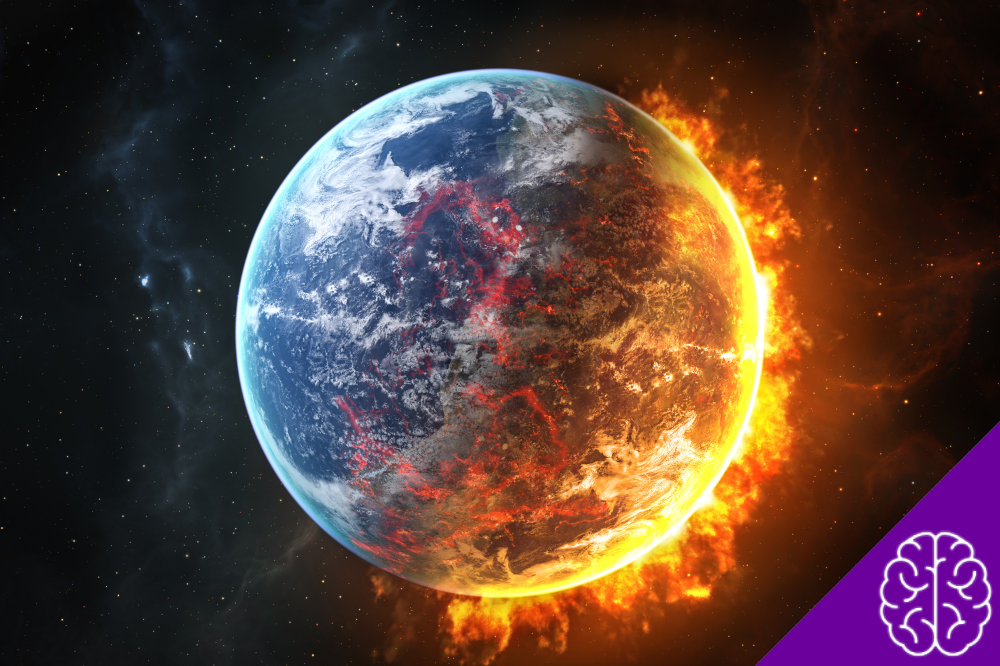
Human extinction has never occurred—but according to many scientists, our species may have come surprisingly close tens of thousands of years ago. A massive volcanic eruption, a mysterious genetic bottleneck, and a changing climate have fueled decades of research into one of humanity’s greatest survival stories.
While no single event has been proven to be the moment that nearly wiped us out, the evidence surrounding the Toba supereruption has made it one of the strongest candidates. Here’s what scientists know, what they still debate, and why this ancient mystery continues to capture attention today.
Why scientists think humanity almost disappeared
When researchers discuss possible human extinction events, one theory appears more often than any other: the eruption of the Toba supervolcano around 74,000 years ago.
Located on the Indonesian island of Sumatra, Toba produced one of the largest volcanic eruptions in Earth’s known history. The explosion released enormous quantities of ash and sulfur into the atmosphere, potentially affecting the global climate for years.
Scientists believe these environmental changes may have made survival much harder for early humans by reducing available food and transforming ecosystems across large parts of the planet.
However, it’s important to understand that this remains a scientific hypothesis—not an established fact.
The eruption that may have changed the world
Unlike ordinary volcanic eruptions, a supereruption has the potential to affect regions thousands of miles away.
Researchers believe the Toba eruption may have caused several major environmental changes, including:
- lower global temperatures;
- reduced sunlight caused by volcanic particles;
- declining plant growth;
- disruptions to food chains; and
- widespread ecological stress.
For small groups of hunter-gatherers, these changes could have been especially dangerous. Early humans depended entirely on natural resources, so even a few years of harsher conditions may have dramatically reduced their chances of survival.
Although scientists still debate exactly how severe these effects were, Toba remains one of the strongest natural events ever linked to a possible human extinction scenario.
The mysterious population bottleneck
Another reason researchers connect Toba with human extinction is a phenomenon known as the population bottleneck.
Genetic studies indicate that modern humans share surprisingly little genetic diversity compared with many other species. One explanation is that our ancestors passed through a period when only a relatively small breeding population survived.
Some early research estimated that the breeding population may have fallen to only a few thousand individuals. If accurate, that would mean every person alive today descended from an exceptionally small group of survivors.
It’s worth noting that “breeding population” does not represent the total number of humans alive at the time. Instead, it refers to the individuals who successfully passed their genes to future generations, which is why genetic estimates can appear much lower than the total population.
Why many scientists remain skeptical
Although the Toba eruption is often associated with human extinction, the theory is far from settled.
Over the past two decades, archaeologists have uncovered evidence suggesting that some human populations continued living in Africa and parts of Asia after the eruption without signs of a catastrophic collapse.
Researchers continue to debate questions such as:
- How severe was the volcanic winter?
- Did different regions experience different impacts?
- Was the population decline already underway before Toba erupted?
- Could several environmental changes have combined to reduce human numbers?
Because of these uncertainties, scientists generally describe Toba as a leading hypothesis rather than proof that humanity nearly disappeared.
Other moments that challenged our species
While Toba receives the most attention, it wasn’t the only period that tested human survival.
During the Ice Age, early humans faced repeated shifts in temperature, expanding glaciers, and changing landscapes. These environmental pressures forced populations to migrate, adapt, and compete for limited resources over thousands of years.
Historians also point to devastating pandemics such as the Black Death. Although the disease killed tens of millions of people, it spread when the global human population was already large enough that human extinction was never considered a realistic possibility.
Today, scientists studying existential risks focus on very different threats, including:
- large asteroid impacts;
- nuclear conflict;
- engineered pandemics; and
- extreme climate-related disruptions.
Unlike the Toba event, these are future risks rather than prehistoric mysteries.
A mystery that science is still unraveling
The search for the closest humanity came to human extinction is about more than a single volcano.
By combining genetics, archaeology, geology, and climate science, researchers continue to piece together how our ancestors survived dramatic environmental changes and why modern humans share such limited genetic diversity.
New discoveries regularly challenge older ideas, which is why the Toba hypothesis continues to evolve instead of becoming settled scientific fact.
Whether the eruption nearly ended our species or simply coincided with an already shrinking population, it remains one of the most remarkable stories in human history—and a reminder of just how resilient humans have been throughout their existence.