

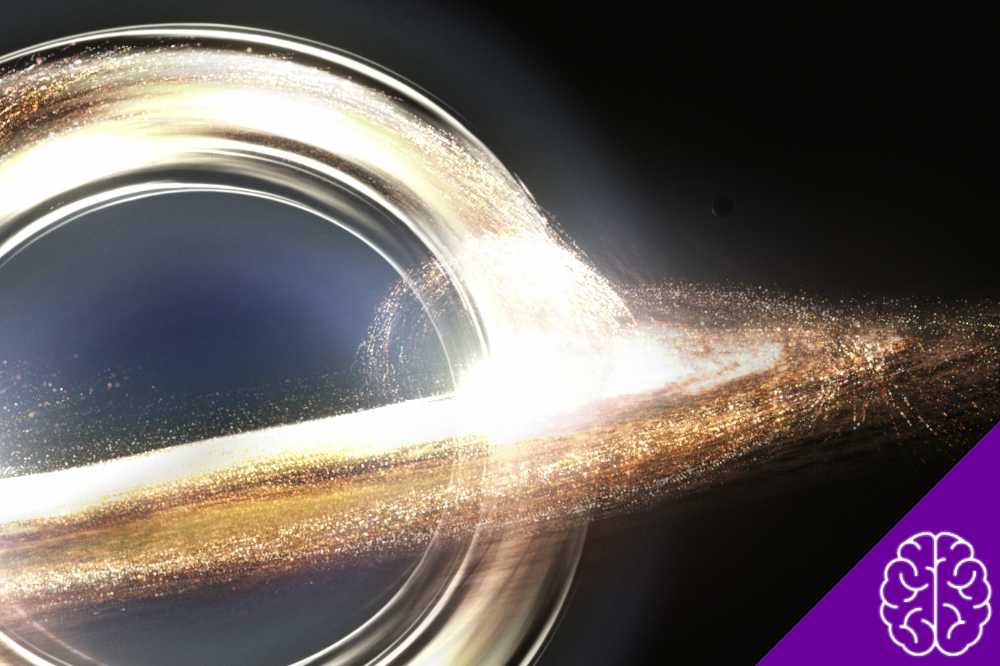
To fall into a black hole is one of the most extreme scenarios physics can imagine. According to Einstein’s theory of general relativity, a black hole’s gravity is so strong that once you cross its event horizon, nothing—not even light—can escape.
While no human has ever experienced this, scientists have used decades of theoretical research and observations to predict what would likely happen. Some effects are well understood, while others remain among the biggest mysteries in modern physics.
What is a black hole?
A black hole is an object with an enormous amount of mass compressed into an extremely small region of space. Its gravity is so powerful that it bends space and time themselves.
Every black hole has a boundary called the event horizon, often referred to as the “point of no return.” Once anything crosses this boundary, it cannot escape back into the universe.
Scientists have identified several types of black holes, including:
- stellar-mass black holes, formed after massive stars collapse;
- intermediate-mass black holes;
- supermassive black holes found at the centers of galaxies.
What happens as you get closer?
Long before reaching the event horizon, gravity begins to behave in unusual ways.
One of the most important effects is that gravity becomes much stronger on the part of your body closest to the black hole than on the part farther away. These differences are called tidal forces.
Whether you notice them depends largely on the size of the black hole. Around a smaller stellar-mass black hole, tidal forces become extreme much earlier. Around a supermassive black hole, they are much weaker near the event horizon, allowing an object to get much closer before experiencing severe stretching.
Spaghettification: the stretching effect
The best-known prediction is spaghettification.
As tidal forces increase, your body stretches in the direction of the black hole while compressing sideways. The effect becomes stronger the closer you get.
According to NASA, this stretching can become so intense that tidal forces literally pull matter apart into a long, thin stream—hence the name “spaghettification.” In some situations involving supermassive black holes, tidal forces may also temporarily compress stars into a “pancake” shape before destroying them.
Time would appear to slow down
Black holes also produce one of the strangest predictions of general relativity: gravitational time dilation.
From the perspective of someone watching from far away, you would appear to move more and more slowly as you approached the event horizon. Eventually, you would seem to freeze near its edge as the light reaching the distant observer becomes increasingly redshifted.
From your own perspective, however, time would continue to pass normally. You would not notice yourself slowing down while falling toward the black hole.
Can you survive crossing the event horizon?
The answer depends on the size of the black hole—but only up to a point.
For a stellar-mass black hole, tidal forces become so intense near the event horizon that they would almost certainly destroy a person before or shortly after crossing it.
For a supermassive black hole, such as the one at the center of the Milky Way, the event horizon is much larger. In theory, an astronaut might cross it without immediately noticing anything unusual because the tidal forces at that location are much weaker.
However, surviving the crossing does not mean surviving indefinitely. As the fall continues toward the center, gravitational forces become increasingly extreme and eventually become fatal. Scientists cannot fully describe what happens at the singularity because current physics breaks down under those conditions.
What happens inside a black hole?
This is where science reaches its limits.
General relativity predicts that matter continues falling toward a region known as the singularity, where density and spacetime curvature become infinite.
However, physicists do not believe this description is complete. At such extreme scales, both general relativity and quantum mechanics are expected to play a role, but there is currently no accepted theory of quantum gravity capable of explaining what actually occurs.
As a result, scientists cannot say with certainty what happens after crossing the event horizon.
Could a black hole be a portal to another universe?
This idea appears frequently in science fiction, but there is no observational evidence that black holes function as portals, wormholes, or gateways to other universes.
Some theoretical models explore the possibility of traversable wormholes or connections between different regions of spacetime. However:
- no wormhole has ever been observed;
- no black hole has been shown to contain a traversable passage;
- current evidence does not support the idea that people or objects could emerge elsewhere after entering a black hole.
For now, these concepts remain speculative and are not established scientific facts.
So, what would really happen if you fall into a black hole?
Based on today’s scientific understanding, the most likely sequence is:
- you would experience increasingly strong gravitational effects;
- tidal forces would stretch your body, eventually causing spaghettification;
- distant observers would see your motion appear to slow dramatically near the event horizon;
- from your perspective, you would continue falling inward;
- what happens beyond the event horizon remains unknown because current physics cannot fully describe conditions inside a black hole.
While black holes are among the best-tested predictions of general relativity, they also highlight some of the biggest unanswered questions in modern physics.
Frequently Asked Questions (FAQ)
Would you feel pain when falling into a black hole?
If tidal forces became strong enough, they would rapidly stretch and compress your body. Scientists agree that these forces would ultimately be fatal, although the exact experience cannot be tested experimentally.
Can light escape from a black hole?
No. Once light crosses the event horizon, it cannot escape, which is why black holes appear dark.
Has anyone ever fallen into a black hole?
No. There is no evidence that any human has fallen into a black hole, and no spacecraft has ever crossed an event horizon.
Can black holes destroy stars?
Yes. When a star passes too close, tidal forces can tear it apart in what astronomers call a tidal disruption event.
Are black holes still being studied?
Absolutely. Observatories such as the Event Horizon Telescope, NASA missions, and gravitational-wave detectors continue to improve our understanding of how black holes form, grow, and interact with the universe.