

Some of the world’s most recognizable monuments contain spaces, engineering details, symbols and historical features that most visitors never notice. These famous landmarks often reveal a very different story when you look beyond their most photographed surfaces.
From a chamber beneath the Lincoln Memorial to an apartment once used by Gustave Eiffel, these details are not based on internet legends. They come from historical records, archaeological research and information provided by the institutions responsible for preserving the sites.
1. The Statue of Liberty has a torch visitors cannot enter
The Statue of Liberty may be one of the most familiar famous landmarks in the United States, but its torch has a history that many visitors do not know.
The current torch is not the original. During the monument’s restoration in the 1980s, workers replaced the original torch, which had suffered significant damage. The replacement features a flame covered in 24-karat gold leaf, while the original torch is now preserved in the Statue of Liberty Museum.
There is another surprising detail: visitors cannot climb into the torch. Access requires a narrow ladder, and the area has remained closed to the public since the 1916 Black Tom explosion. National Park Service personnel can access it for maintenance.
Visitors can, however, climb to the crown. The route involves a confined spiral staircase and at least 162 steps from the pedestal to the crown level.
What visitors can access:
- the pedestal;
- the crown, with advance reservations;
- the Statue of Liberty Museum;
- the original torch, which is displayed inside the museum.
2. The Lincoln Memorial has a massive space underneath it
The Lincoln Memorial looks like a classical Greek temple, but a large structural space sits beneath the monument.
Known as the undercroft, this cavernous area contains a grid of concrete columns supporting the memorial above. For decades, it remained largely unseen by the public. In 2026, the National Park Service opened a new visitor experience in the space, including exhibits about the memorial’s construction and its role in American history and the civil rights movement.
The undercroft covers approximately 15,000 square feet. Its existence illustrates how much engineering sits beneath a structure that appears relatively simple from the outside.
There is also a less obvious detail inside the main chamber. The Lincoln sculpture incorporates fasces, an ancient Roman symbol associated with authority, into the armrests. The National Park Service notes that the symbol appears repeatedly throughout the memorial and forms part of its intended symbolism.
So, beneath and within the memorial, visitors can find:
- a large structural undercroft;
- engineering elements supporting the monument;
- historical exhibits;
- symbolic architectural details.
3. Mount Rushmore was supposed to tell a bigger story
Mount Rushmore is famous for its enormous presidential faces, but sculptor Gutzon Borglum originally envisioned a much more ambitious addition.
He planned an inscription known as the Entablature, which would describe important events in American history. The proposed feature would have been carved into the mountain near the figures, but the project ultimately proved impractical because of the scale and difficulty involved.
Borglum later pursued another idea: a Hall of Records hidden behind the sculpted faces. He envisioned a repository containing important documents and information about the United States.
The chamber was never completed according to his original vision. However, workers did create an entrance and tunnel, and a small vault was eventually placed inside with porcelain panels containing historical documents and text.
The unfinished project therefore left behind more than an abandoned idea:
- Borglum’s original plans included a historical inscription;
- he later proposed a Hall of Records;
- workers excavated an entrance and tunnel;
- a small vault was eventually installed inside.
The National Park Service preserves the history of this unfinished feature.
4. The Eiffel Tower really had a private apartment
One of the most famous stories about the Eiffel Tower sounds like a rumor, but this one is documented by the tower’s official website.
Gustave Eiffel had a private space near the summit of the tower. Rather than functioning simply as a luxury residence, it served several purposes. Eiffel used it as an office, laboratory and place where he could receive distinguished guests.
Because ordinary visitors could not access the space, stories about his supposed “secret apartment” eventually became part of the tower’s mythology.
Part of the apartment has been preserved. Visitors can look through a window at a reconstruction containing wax figures representing:
- Gustave Eiffel;
- his daughter Claire;
- Thomas Edison.
The detail is particularly interesting because it reveals that the Eiffel Tower was not designed solely as a monument or observation point. Eiffel also used the structure for scientific experiments and technical work.
5. The Colosseum hid an entire mechanical system underground
The Colosseum’s most dramatic events took place above ground, but much of the machinery that made those spectacles possible remained hidden beneath the arena.
The underground levels contained:
- corridors and rooms;
- trapdoors;
- hoists;
- elevators;
- spaces for animals, people and scenery.
According to the Archaeological Park of the Colosseum, the underground system included 28 freight elevators during the Flavian period, operated by windlasses. These mechanisms allowed elements of the spectacles to rise into the arena from below.
The original underground structures were built largely in wood for the Colosseum’s inauguration in 80 AD. Emperor Domitian later oversaw their transformation into masonry structures.
Today, visitors can explore parts of these underground levels through specific tours and ticketed experiences. What once functioned as backstage infrastructure is now an important archaeological part of the monument.
6. The Washington Monument changes color for a historical reason
The Washington Monument appears to be a single stone obelisk, but its exterior reveals a visible record of its interrupted construction.
Work on the monument stopped in 1854 after the Washington National Monument Society ran out of money. When construction resumed roughly two decades later, builders could no longer obtain the same stone used during the first phase.
They turned to different quarries, and the resulting marble did not match perfectly. Today, visitors can see the change in color roughly one-third of the way up the monument, creating a visible line between different construction periods.
The interior contains another unusual historical feature: 193 commemorative stones contributed by individuals, organizations, cities, states and countries.
These details reveal two different stories about the monument:
- the visible color change records its interrupted construction;
- the commemorative stones reflect contributions from different groups.
Together, they make the building itself a record of its history.
7. Petra is full of passages, tunnels and water systems
Petra is often associated with its spectacular rock-cut façades, but the ancient city extends far beyond the structures most visitors recognize.
UNESCO describes Petra as a city surrounded by mountains containing numerous passages and gorges. Its archaeological remains include:
- channels;
- tunnels;
- diversion dams;
- cisterns;
- reservoirs.
These features formed an extensive water-management system.
That infrastructure was crucial because Petra developed in an arid environment. Rather than simply depending on natural water sources, the Nabataeans developed sophisticated systems to capture, transport and conserve seasonal rainfall.
The hidden engineering is arguably just as impressive as the famous façades. It demonstrates how the city’s inhabitants adapted their architecture and infrastructure to the surrounding landscape.
8. The Taj Mahal’s visible tombs are not the actual graves
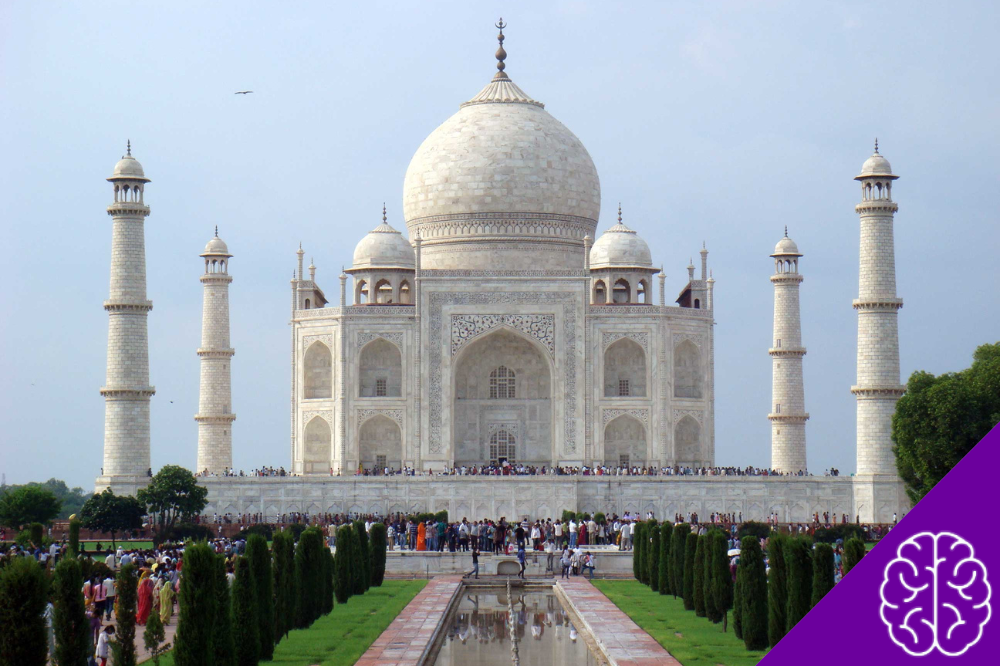
The Taj Mahal is famous for its extraordinary symmetry, marble decoration and central chamber. Yet one detail is easy to miss: the prominent cenotaphs visitors see inside the monument are not the actual graves.
UNESCO explains that the visible cenotaphs are symbolic. The real graves of Mumtaz Mahal and Shah Jahan are located in a lower chamber, following the tradition of Mughal imperial tombs.
There is another detail that affects the monument’s famous symmetry. Shah Jahan’s cenotaph was installed later and sits beside Mumtaz Mahal’s rather than maintaining the building’s otherwise carefully balanced arrangement.
This distinction separates three elements that can easily be confused:
- the visible cenotaphs are symbolic;
- the actual graves are in a lower chamber;
- Shah Jahan’s later burial altered the symmetry of the interior.
The arrangement is part of the architectural and funerary tradition rather than a hidden mystery.
Why these hidden details matter
The most interesting secrets behind famous landmarks are often not mysterious rooms or legendary treasures. They are details that reveal how people actually designed, built, used and changed these places over time.
An inaccessible torch, an unfinished historical archive, an underground mechanical system or a visible change in building materials can tell us more about a landmark than its postcard view ever could.
These discoveries also show why reliable historical sources matter. Many popular stories surrounding famous monuments mix documented facts with myths, while the actual history can be just as fascinating without embellishment.
Looking beyond the most recognizable feature can turn a familiar landmark into a much more fascinating piece of history.