

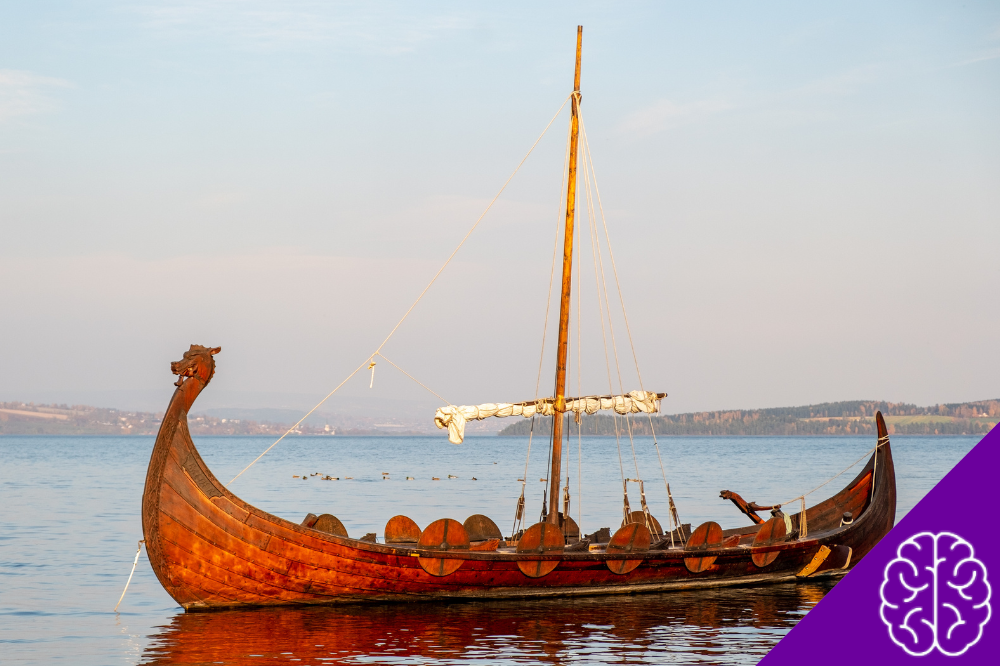
The story of viking sunstones connects Norse history, maritime exploration, and optical science. These mysterious crystals may have helped sailors estimate the Sun’s position when clouds obscured the sky.
Medieval texts and modern experiments offer clues, but one question remains: did Viking sailors actually use these crystals to navigate the North Atlantic?
What Were Viking Sunstones?
Viking sunstones, known in Old Norse as sólarsteinn, appear in medieval Icelandic literature. Some accounts describe a stone that could help locate the Sun under overcast conditions.
Researchers have not identified the exact mineral described in these texts. One leading candidate is Iceland spar, a transparent variety of calcite.
Its optical properties make it particularly interesting:
- It allows light to pass through.
- It produces double refraction, splitting light into two rays.
- It can help reveal information about polarized light.
According to research discussed by the Royal Society, these properties could have helped a navigator estimate the Sun’s direction.
However, historical texts do not confirm the crystal’s exact composition or establish how frequently sailors used it.
How Could a Sunstone Help Sailors Navigate?
The theory relies on light polarization. When sunlight enters Earth’s atmosphere, air molecules scatter it and create a pattern of polarized light across the sky.
A suitable crystal could help a navigator interpret that pattern, even when clouds hide the Sun.
How the proposed method works
- Rotate the crystal. The sailor changes its orientation while observing the light passing through it.
- Compare the light. Changes in brightness or appearance provide clues about its polarization.
- Estimate the Sun’s position. The sailor uses the observed pattern to infer the direction of the hidden Sun.
This technique would not work like a modern magnetic compass. Instead, it could provide a directional reference to combine with other observations.
Weather would still matter. Thin clouds might leave a detectable polarization pattern, while heavy cloud cover could make the method much less reliable.
Which Crystals Could Have Worked as Sunstones?
Iceland spar receives the most attention, but scientists have investigated other minerals with useful optical properties.
Iceland spar (calcite)
This transparent mineral produces double refraction. When someone looks through it, an object may appear doubled. Rotating the crystal changes the relative appearance of the images, helping an observer analyze polarized light.
Cordierite
Cordierite has optical properties that could help analyze the polarization of skylight. Researchers have considered it as another possible material for this type of navigation.
Tourmaline
Tourmaline also interacts with polarized light, making it another candidate scientists have investigated.
A 2011 study published in Philosophical Transactions of the Royal Society B examined atmospheric conditions relevant to navigation using sky polarization.
These properties make the proposed technique plausible. They do not establish which mineral, if any, Viking sailors actually carried.
What Does the Historical Evidence Tell Us?
The main historical evidence comes from medieval Icelandic literature.
Two works associated with the discussion are Rauðúlfs þáttr and Hrafns saga Sveinbjarnarsonar. Their references to sunstones have encouraged researchers to investigate whether these objects served a practical purpose.
What the texts establish:
- Medieval accounts mention a stone associated with locating the Sun.
- At least one account describes its use under overcast conditions.
- The descriptions lack enough technical detail to identify the mineral conclusively.
What about archaeological discoveries?
Researchers have not identified an artifact conclusively proven to be a Viking-era sunstone used for navigation.
A frequently discussed discovery comes from a 16th-century shipwreck near Alderney, in the English Channel. Researchers found a calcite crystal there, raising the possibility that sailors used crystals for optical purposes.
The discovery is intriguing, but the wreck dates centuries after the Viking Age. It cannot establish that Norse sailors used the same technique.
The historical evidence therefore supports further investigation, not a definitive conclusion about the role of sunstones in Norse navigation.
Have Scientists Tested the Viking Sunstone Theory?
Yes. Researchers have investigated whether crystals could help sailors estimate the Sun’s position through experiments and computer simulations.
What the studies found
2011: Research on optical navigation
A study in Philosophical Transactions of the Royal Society B examined how sky polarization could support navigation when the Sun was not directly visible.
2018: Simulations of North Atlantic voyages
Researchers modeled possible journeys between Norway and Greenland. Their results suggested that polarization-based navigation could work under certain conditions if sailors checked their direction regularly.
Read the study in Royal Society Open Science.
2026: Analysis of the theory’s limitations
An article in The American Journal of Physics examines the proposed technique and its scientific limitations, including difficulties observing polarization when clouds obscure the relevant sky pattern.
These studies support the scientific possibility of the technique, not its confirmed use during the Viking Age.
Computer simulations test scenarios based on specific assumptions. They cannot prove that historical sailors followed the modeled procedure or achieved the same results.
How Did Vikings Navigate Without Sunstones?
Viking sailors could combine several sources of information instead of relying on a single instrument.
- The Sun: Its position provided a directional reference when the sky was clear.
- The stars: Nighttime observations could help sailors orient themselves, although long summer daylight limited their usefulness at northern latitudes.
- Winds and waves: Experience with ocean conditions and prevailing winds helped sailors understand their surroundings.
- Coastlines and landmarks: Familiar geographic features helped sailors establish their position when traveling near land.
Long stretches of open water made navigation more challenging. Even so, Viking maritime skills could develop through observation, experience, and knowledge passed between generations.
A sunstone might have complemented these methods, but researchers have not established that it formed part of standard Viking navigation.
Were Viking Sunstones Real Navigation Tools?
The answer depends on the distinction between scientific possibility and historical proof.
What we know:
- Medieval Icelandic texts mention sunstones.
- Certain crystals can help analyze polarized light.
- Experiments and simulations show how this property could support navigation.
What remains unproven:
- Which mineral the historical texts describe.
- Whether Viking sailors routinely carried these crystals.
- Whether they used them to navigate the North Atlantic.
For now, viking sunstones remain a compelling possibility rather than a confirmed navigational technology. Scientific research shows how the technique could work, but stronger historical evidence is needed to establish whether Viking sailors actually used it.