

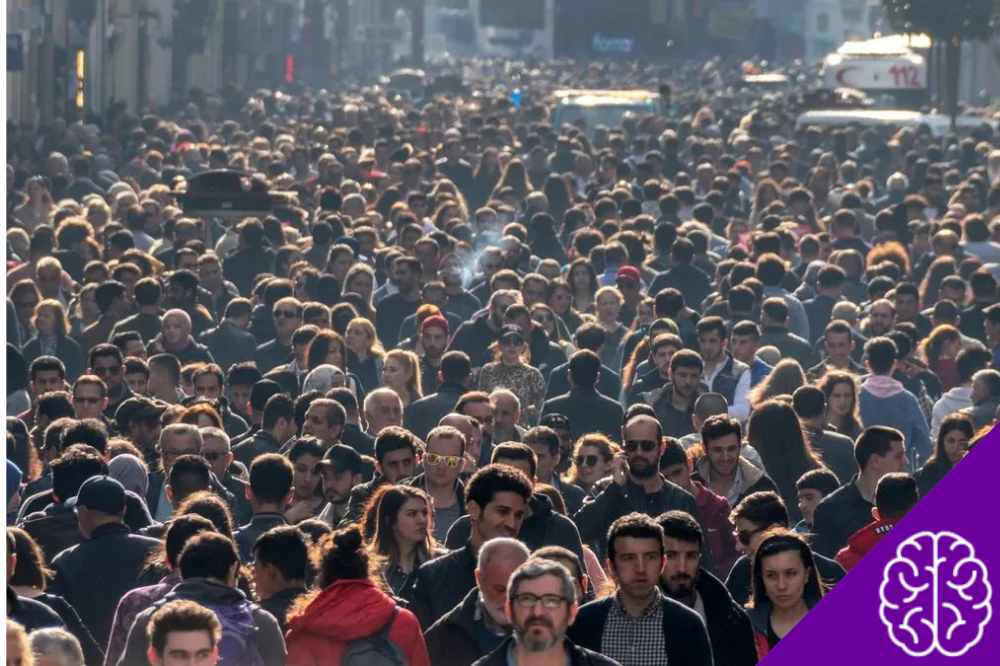
We currently share our planet with nearly 8 billion other human beings. It is a staggering figure, one that is difficult to visualize. If you were to count one person every second, it would take you over 250 years to reach the current global population. As our cities expand and our demand for resources intensifies, a critical question arises: is there a limit?
Decades ago, human activity crossed a significant threshold. We began consuming natural resources faster than the environment could regenerate them, effectively breaking the planet’s cycle of “self-healing.” We are no longer just living off the interest of our ecological capital; we are eating into the principal.
This reality brings us back to the age-old debate regarding Earth’s carrying capacity. Is there a magic number where the planet simply says “enough”? While the answer is complex, understanding the history of our growth and the limitations of our resources provides a clearer picture of where we are heading.
The Explosive History of Human Growth
To understand where we are going, we have to look at where we started. The history of human population growth is not a steady incline; it is a long, flat line followed by a sudden, massive spike.
According to scientific estimates, Homo sapiens first appeared approximately 300,000 years ago. For the vast majority of our history, we were few in number.
Experts estimate that for thousands of years, the total human population hovered between just 100 and 10,000 individuals. We were a small, fragile species fighting for survival.
The Agricultural Catalyst
The first major shift occurred with the invention of agriculture between 10,000 and 15,000 years ago. This innovation allowed us to settle down and secure more reliable food sources. At that time, there were likely between 1 and 10 million people on Earth.
While this seems small by modern standards, agriculture accelerated our growth rate significantly. It took about 1,500 years for the population to double during this era. As farming techniques improved, that doubling time shrank to just 300 years.
The 20th Century Boom
If the agricultural revolution lit the match, the 20th century poured gasoline on the fire. Between 1930 and 1974, the global population doubled in just 44 years. This period marked the fastest expansion in human history, with growth rates peaking in the 1960s.
However, this rapid acceleration has since begun to cool down. While the total number of people is still rising, the rate at which we are growing has slowed.
Fertility Rates and Future Projections
A key factor in this slowdown is the dramatic drop in fertility rates. In 1950, the average woman gave birth to 5.05 children. By 2020, that number had fallen to 2.44 children per woman.
As education levels rise and access to healthcare improves globally, families are choosing to have fewer children.
Despite this decline in fertility, our momentum continues. We expect to reach the 8 billion mark by 2023. Currently, the time it takes for the population to double has extended to 49 years.
Looking further ahead, projections suggest that the global population will eventually stabilize. By the year 2100, experts predict there will be between 10 and 12 billion people on Earth.
This stabilization might sound like good news, but it may come with a harsh reality check. If we hit the absolute ceiling of Earth’s carrying capacity, nature may force a balance through rising mortality rates caused by famine and disease.
The Resource Reality Check
The question “how many people can Earth support?” is actually the wrong question. The better question is “how many people can Earth support at what standard of living?“
The planet’s ability to sustain us is not just about physical space. It is about the ecological footprint we leave behind. There are three main bottlenecks we face: carbon, food, and water.
The Carbon Conundrum
Our impact on the climate is perhaps the most pressing limit to our growth. Currently, the global average for carbon emissions is about 5 tons per person per year. However, this average hides massive disparities.
In the United States, the average resident emits closer to 17 tons of carbon annually. This disparity highlights a terrifying hypothetical: if 3 billion more people join the global population and adopt the lifestyle and consumption habits of the average American, the ecological results would be catastrophic.
Global warming is projected to raise Earth’s temperature by two degrees Celsius by the end of this century.
This shift will lead to more extreme weather conditions, which in turn disrupts agriculture. If the climate becomes too volatile, our ability to produce enough food for 10 billion people diminishes rapidly.
The Water Crisis
While our planet appears blue from space, the amount of accessible, fresh water is incredibly limited. Humans currently utilize about 30% of Earth’s renewable and accessible water supply. The vast majority of the remaining supply is diverted to agriculture to grow the food we eat.
The strain is already showing. In many regions, available water is not clean enough to drink, leading to health crises that disproportionately affect the poor.
As the population grows, the competition for this finite resource between thirsty cities and hungry farms will only intensify.
It’s Not a Fixed Number
So, what is the final number? Is it 10 billion? 15 billion?
The truth is that the carrying capacity of Earth is not a fixed statistic. It is a sliding scale that depends entirely on human behavior.
Variables such as technological innovation, food distribution, and energy consumption all play a role in determining how many of us can live here safely.
The way we produce and consume natural resources today dictates the planet’s ability to support the generations of tomorrow.
If we continue with current consumption patterns—particularly those of wealthy nations—the limit is much lower. If we transition to sustainable energy, reduce waste, and improve resource distribution, the planet can support more lives with less strain.
The Choice is Ours!
The Earth has limits, but we have agency. The stabilization of the human population between 10 and 12 billion is likely inevitable, but the quality of life for those billions is not yet written.
The answer lies in the mode of production and consumption. It depends on who has access to resources and how efficiently we use them.
We are rapidly approaching the planet’s boundaries, but with conscious changes to our carbon footprint and resource management, we can ensure that Earth remains a viable home for everyone!