

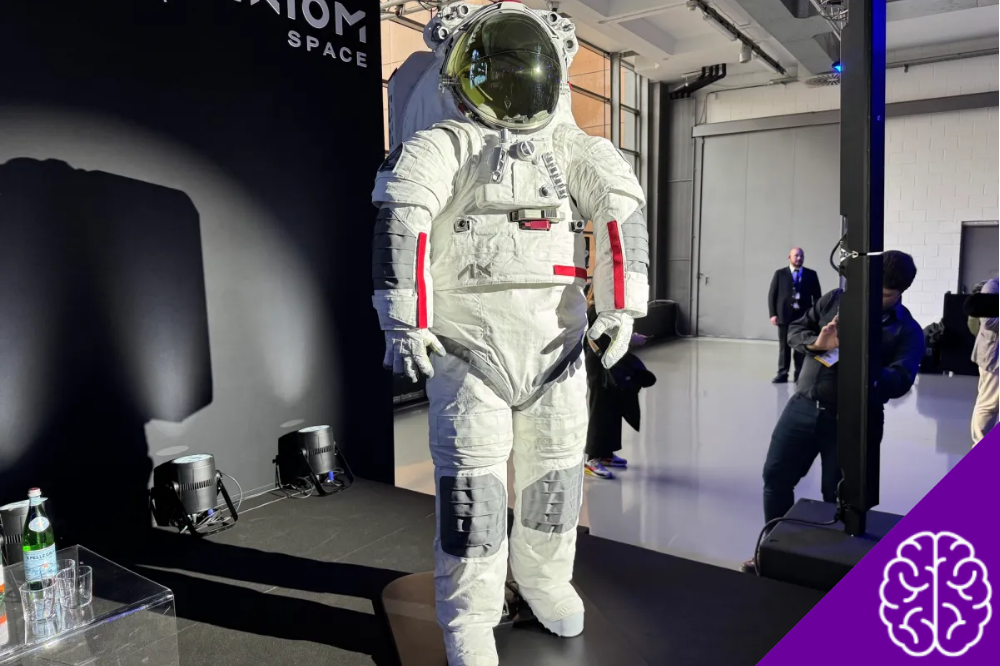
Life in space is physically demanding. Astronauts on long missions face challenges like muscle atrophy and reduced bone density due to low gravity. Even simple movements inside a pressurized spacesuit can be strenuous. To address these issues, scientists are developing innovative technologies to make space exploration safer and more efficient.
One of the most promising advancements comes from the University of Bristol in England. Researchers there have created an experimental spacesuit equipped with artificial muscles.
This wearable robotic exoskeleton, or “exosuit,” is designed to reduce astronaut fatigue and improve physical performance. This article from the Insight Factory will explore how this cutting-edge technology works, its recent testing, and its potential applications both in space and on Earth.
How the Exosuit Works of the Artificial Muscles
The new exosuit, developed by the university’s VIVO Hub, combines robotics, biotechnology, and textile design.
It functions as a wearable support system that can be worn under a conventional spacesuit. The goal is to provide assistance to astronauts, making their movements less strenuous.
A “Muscle” You Can Wear
The suit is constructed from lightweight, flexible materials. It features an outer layer of nylon and an inner layer of thermoplastic, which provide both durability and thermal insulation.
Key structural components, such as belts and knee bands, are made from Kevlar, the same high-strength synthetic fiber used in bulletproof vests.
The core of the technology lies in its “smart fibers.” These artificial muscles can contract and relax much like human muscles, effectively boosting the user’s strength and reducing physical effort.
The suit can be adjusted to either assist or resist movement, depending on the task. This dual functionality means it can help astronauts lift heavy objects or provide resistance for exercise to maintain muscle mass.
Testing in a Simulated Lunar Environment
The exosuit’s capabilities were recently put to the test at the CRATER facility at the University of Adelaide in Australia.
This large-scale simulation mimics the conditions of the lunar surface, including its soil and varied lighting. The experiment brought together over 200 researchers from 25 countries to evaluate new space technologies.
During the tests, “analog astronauts”—volunteers who simulate space mission routines in a controlled setting—wore the exosuit.
They performed activities like walking, climbing, and carrying equipment across the uneven, simulated lunar terrain. Researchers measured biomechanical indicators, energy consumption, and fatigue levels.
Preliminary results from these experiments are promising. The data shows that the exosuit significantly reduced muscle strain and improved movement efficiency, particularly during long-duration tasks. This suggests the technology could be a game-changer for future missions to the Moon and Mars.
Beyond Space Exploration
While the primary focus of the exosuit is to support astronauts, its potential applications extend far beyond space. The technology holds significant promise for helping people with motor impairments here on Earth.
Emanuele Pulvirenti, a research associate at the University of Bristol and a co-author of the study, highlighted the suit’s versatility.
“The assistive exoskeleton can artificially increase leg strength, while a resistive version helps to preserve muscle mass,” he explained.
This could make it an invaluable tool in physical therapy and rehabilitation for individuals recovering from injury or managing chronic conditions.
The development team’s next goal is to integrate sensors and autonomous systems into the suit. This would allow it to react in real-time to the user’s movements and bodily signals, creating a more natural and adaptive experience.
The Future of Wearable Space Tech
This project is part of a growing trend in wearable technologies for space exploration. Agencies like NASA, the European Space Agency (ESA), and the UK Space Agency are all investing in similar research.
The development of such technologies is considered essential for the success of long-duration lunar missions, like the Artemis program, and for the eventual goal of sending crewed expeditions to Mars.
These advanced suits are moving beyond simple protection. As Pulvirenti stated in the university’s announcement, “We are just at the beginning of a new era where the spacesuit will not only be a protection but an intelligent extension of the human body.”
Innovations like the artificial muscle exosuit are paving the way for a future where technology and the human body work together to push the boundaries of exploration.
A Leap for Human Mobility!
The development of a spacesuit with artificial muscles represents a significant step forward for both space travel and terrestrial medicine.
By reducing the physical strain on astronauts and offering new rehabilitation possibilities on Earth, this technology has the potential to improve lives in multiple ways.
As research continues, we can expect to see even more sophisticated wearable systems that enhance human capabilities, whether on distant planets or closer to home!