

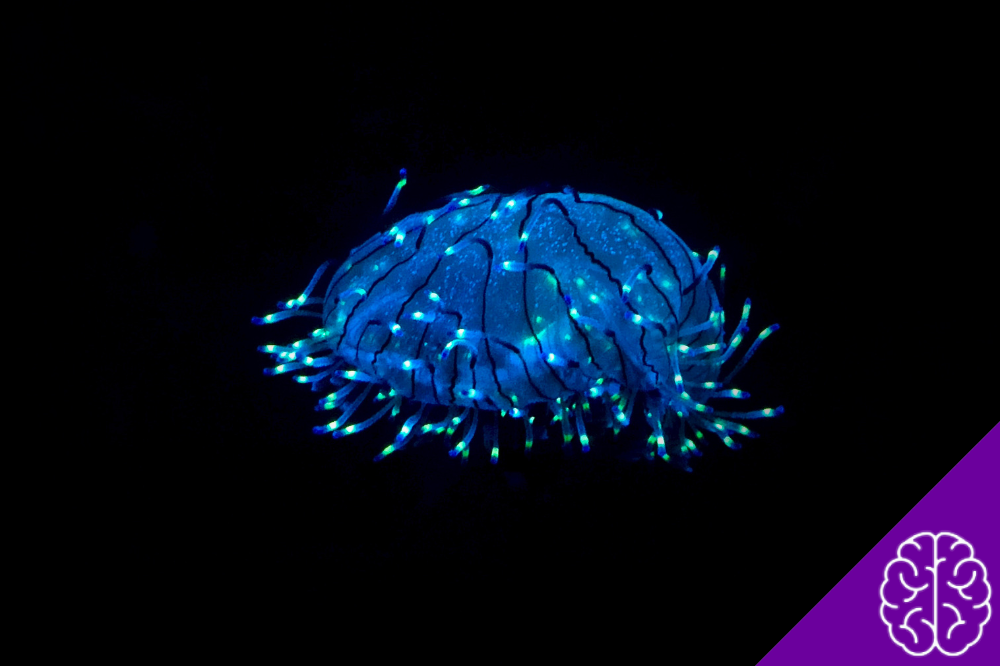
Seeing an animal glow in the dark may seem like something from a science-fiction movie, but bioluminescence is a real biological ability found across many species. Fireflies are the most familiar example on land, while marine environments contain an enormous variety of organisms that produce their own light.
The glow is not simply a striking visual feature. For the animals that use it, light can help with feeding, defense, reproduction and communication. In some cases, it can even make an animal harder to see.
What is bioluminescence?
Bioluminescence is the production and emission of visible light by a living organism. It occurs through a chemical reaction that converts energy into light.
The exact chemistry varies among species. A common system involves a light-producing molecule called luciferin and an enzyme called luciferase. When the reaction occurs under the right conditions, energy is released as photons, producing visible light.
Not every animal produces all of the components itself. Some species depend on bioluminescent bacteria living in specialized parts of their bodies. Others obtain substances involved in light production through their diet.
Different groups have therefore developed different chemical systems and structures for generating and controlling light. Bioluminescence is not one single mechanism shared by every glowing organism.
Why do animals glow in the dark?
Animals use bioluminescence for different biological purposes. The same ability to produce light can help one species find food while helping another avoid becoming food.
Depending on the species, the glow can be used for:
- attracting prey;
- communicating with other individuals;
- attracting mates;
- startling or distracting predators;
- warning potential predators;
- reducing an animal’s visible outline.
Some animals use a dedicated glowing structure, while others produce flashes or release luminous material into the surrounding water. The form of the signal often reflects what the animal needs to accomplish.
Researchers have also found that animals developed bioluminescence independently in multiple evolutionary lineages. A 2024 inventory documented thousands of marine species with confirmed or potentially confirmed luminescence, showing how widely the trait occurs in marine life.
How does an animal produce light?
The chemistry behind the glow depends on the organism.
In a common type of reaction, luciferin reacts with oxygen, while luciferase helps catalyze the process. Other organisms use different molecules or organize their light-producing chemistry through specialized structures.
Some animals contain light-producing cells or organs called photophores. Others house bioluminescent bacteria inside specific parts of their bodies.
The ability to control the light is also important. An animal may need to produce a brief flash, maintain a glow or change the timing or intensity of its signal. Some species can also produce different colors.
This control allows bioluminescence to function as more than a constant source of illumination. The timing, location and appearance of the light can all contribute to its biological purpose.
How does bioluminescence help animals find food?
For some predators, light works as a lure.
The deep-sea anglerfish is one of the best-known examples. Female deep-sea anglerfish can have a specialized structure called an esca, which acts as a glowing lure. In many species, bacteria living inside the structure produce the light.
The lure can attract prey toward the fish’s mouth, allowing the predator to use light as part of its feeding strategy.
Other organisms use bioluminescence in a less direct way. Producing light can help an animal see or detect its surroundings when sunlight provides little or no useful illumination.
In an environment where visual information is limited, creating a controlled source of light can therefore provide an important advantage during feeding.
Can glowing animals use light to avoid predators?
Bioluminescence can also help animals defend themselves.
A sudden flash may startle or distract a predator. Some marine animals can release luminous material into the surrounding water, creating a glowing disturbance that can interfere with a predator’s ability to track them.
Another defense is called counterillumination.
Some squid and other marine animals have photophores on the underside of their bodies. When a predator looks upward from below, the animal could otherwise appear as a dark silhouette against the brighter water near the surface.
By producing light from below, the animal can reduce that contrast and make its outline harder to detect.
In this case, bioluminescence does the opposite of what people might expect: the light helps the animal become less visible.
Do animals use bioluminescence to communicate?
Light can also carry information between members of the same species.
Fireflies are the most familiar example. Their flashes can follow species-specific patterns that help individuals identify potential mates. Because different species use different patterns, the signals can also help individuals recognize the correct species.
Marine animals use visual signals as well. Some produce flashes or other patterns of light that can be associated with mating, social interactions, feeding or responses to danger.
The meaning of a signal depends on the species. A short flash, repeated sequence or particular color can convey information that another individual of the same species is equipped to recognize.
Why is bioluminescence so common in the ocean?
The underwater environment creates many situations in which biological light can be useful.
Sunlight becomes increasingly limited as depth increases. In the deep sea, animals cannot depend on sunlight to illuminate their surroundings, so light produced by living organisms can become an important source of visual information.
Bioluminescence occurs across many marine groups, including bacteria, algae, jellyfish, worms, crustaceans, fish and other animals. It can appear in organisms that live near the surface as well as those found in much deeper waters.
The variety of glowing marine life is also connected to the many different jobs that light can perform. One species may use it to hunt, another to avoid predators and another to communicate.
Why are some animals bioluminescent while others are not?
Having the ability to produce light does not automatically benefit every species.
The usefulness of bioluminescence depends on the animal’s habitat, behavior and way of life. A species living in darkness may benefit from producing light, while another living in a well-lit environment may gain little from the same ability.
Animals also have many other ways to survive in environments where visibility is difficult. Some rely on camouflage, sensitive vision, chemical defenses or behaviors that reduce their chances of being detected.
The evolutionary history of the trait helps explain this diversity. Scientists have found evidence that bioluminescence evolved independently in many different groups rather than originating from one ancestral animal with a single light-producing system.
As a result, two glowing animals may produce light for entirely different reasons and through different biological mechanisms.
What makes bioluminescence different from fluorescence?
Bioluminescence and fluorescence both involve visible light, but they work in different ways.
Bioluminescence produces light through a chemical reaction inside a living organism. Fluorescence, by contrast, occurs when a substance absorbs light from an external source and then re-emits it at another wavelength.
The distinction matters because a fluorescent animal is not necessarily producing its own light.
A fluorescent organism needs an external source of illumination for the effect to appear. A bioluminescent organism can generate visible light through its own biological system.
A biological tool, not just a glow
Bioluminescence may look like a spectacular visual effect, but animals use it for practical biological purposes.
A glowing lure can bring prey closer. A flash can confuse a predator. Light produced beneath a squid can reduce its silhouette, while a carefully timed signal can help a firefly find a mate.
The chemistry and structures behind these behaviors vary widely, and scientists continue to identify new examples across marine environments. What looks like a simple glow is therefore the result of many different evolutionary solutions to the challenges of survival.