

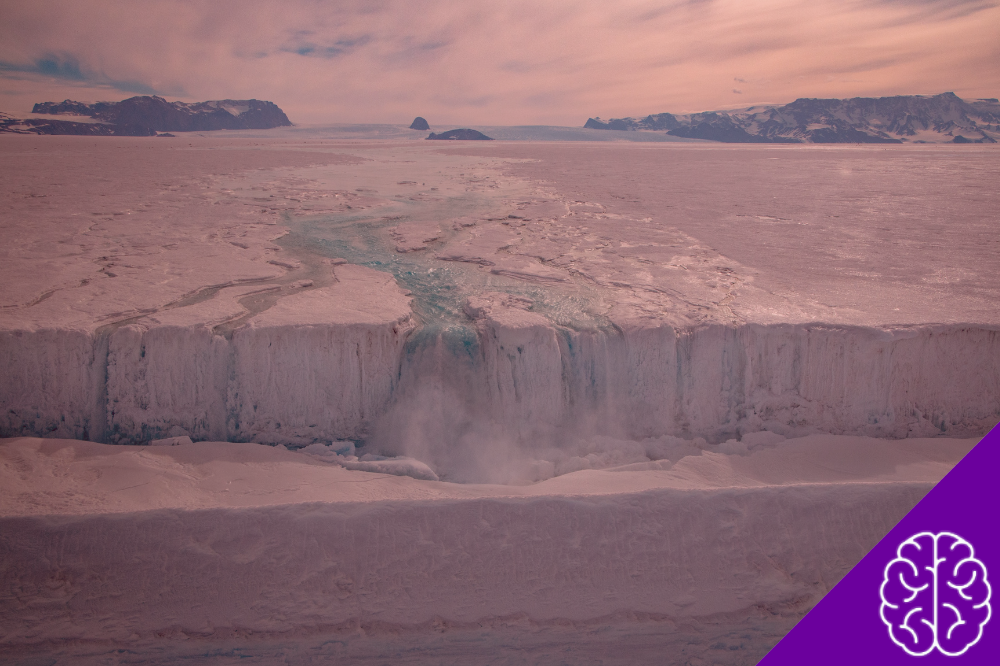
Blood Falls is one of Antarctica’s most unusual natural features: a deep red stain flowing from the edge of a glacier into an otherwise frozen landscape. Its color comes from a natural chemical reaction involving iron-rich, salty water.
Located in the McMurdo Dry Valleys, this phenomenon has fascinated scientists for more than a century. Its unusual chemistry, hidden water system, and microbial life reveal surprising details about Antarctica’s geological history and the limits of life in extreme environments.
Where is Blood Falls located?
Blood Falls emerges from the lower end of Taylor Glacier in the McMurdo Dry Valleys of East Antarctica. The reddish outflow travels across the ice toward Lake Bonney, a permanently ice-covered lake.
The surrounding landscape looks very different from the snow-covered Antarctica many people imagine. The McMurdo Dry Valleys feature:
- Exposed rock and gravel instead of extensive snow cover.
- Permanently frozen lakes.
- Very little precipitation.
- Strong winds that prevent snow from accumulating across large areas.
Against this muted landscape, the red streak stands out immediately. Salty water escapes through a fracture near the glacier’s edge, leaving rusty-colored deposits on the ice.
Unlike a conventional waterfall, Blood Falls does not flow continuously. Its discharge happens in occasional episodes, making each outflow an opportunity for scientists to study the hidden system.
Why does Blood Falls look red?
The distinctive color comes from iron-rich brine trapped beneath Taylor Glacier. This water contains high concentrations of dissolved salts and iron.
When the brine reaches the surface and encounters oxygen, the iron oxidizes and forms reddish compounds that stain the surrounding ice.
How the red color develops:
- Iron-rich brine remains trapped beneath the glacier.
- Salty water escapes through an opening in the ice.
- The dissolved iron encounters oxygen.
- Oxidation produces reddish compounds that stain the ice.
The process resembles rust forming on metal, although the chemical reactions take place in a very different environment. The water does not emerge as a bright red liquid. Instead, its contact with oxygen produces the familiar red-orange appearance.
Scientists once considered several possible explanations for the unusual color, including red algae. Research eventually identified iron as the source of the stain.
This discovery revealed that the visible color points to a much more complex water system beneath the glacier. Blood Falls offers a glimpse into an environment that researchers cannot easily observe directly.
How can salty water remain liquid beneath Antarctic ice?
The brine beneath Taylor Glacier can remain liquid even at extremely low temperatures because its high salt concentration lowers water’s freezing point.
As ice forms, much of the dissolved salt stays in the remaining liquid, making the brine increasingly concentrated.
This process helps explain how water can move through a glacier in a region where surface temperatures remain far below freezing. Researchers have identified brine-filled pathways within and beneath the ice, suggesting a more complex system than a single underground reservoir.
The water may also have an ancient marine origin. Geochemical evidence suggests that seawater entered Taylor Valley during a warmer period in Antarctica’s past. As the glacier advanced, it eventually isolated the salty water from the ocean.
Scientists continue to investigate how long the brine has remained trapped and how its pathways have changed over time.
What causes the red water to flow out?
Blood Falls does not release water at a constant rate. The brine emerges during occasional discharge events, and researchers are still investigating what triggers them.
The pressure and movement of the overlying glacier appear to play important roles.
A 2026 study examined an observed discharge event from 2018 using:
- GPS measurements.
- Time-lapse images.
- Temperature records from Lake Bonney.
Researchers found that the outflow coincided with a roughly 15-millimeter drop in the glacier’s surface and a slowdown in its movement.
These observations suggest that changes in pressure beneath the ice can open pathways for brine to escape. The draining water may also affect the temperature and chemistry of the nearby lake.
However, the study focused on one particular event. Scientists need further observations to understand how consistently glacier movement and pressure changes control the outflow.
Each discharge event offers another opportunity to study the relationship between moving ice and the liquid water hidden beneath it.
Could anything live beneath Taylor Glacier?
One of the most remarkable discoveries associated with Blood Falls is the presence of microbial life in its brine.
Researchers have identified microorganisms that survive in conditions that would challenge most forms of life. Their environment has several unusual characteristics:
- Extremely low temperatures.
- High salt concentrations.
- Little to no sunlight.
- Limited access to fresh nutrients.
These organisms do not depend on sunlight in the same way plants do. Some obtain energy through chemical reactions involving iron and sulfur compounds. They can also use limited organic material and carbon sources within the isolated environment.
Their survival demonstrates how life can adapt to extreme conditions. The ecosystem beneath Taylor Glacier gives scientists an opportunity to study how microorganisms function when light, oxygen, and fresh nutrients are scarce.
It also raises questions about how long isolated microbial communities can persist and how they respond to environmental changes.
What did scientists discover about ancient marine life in 2026?
Research published in Nature Geoscience in August 2026 added another layer to the story.
Researchers analyzed 167 samples of water, sediment, and air from the McMurdo Dry Valleys and nearby marine environments. They identified a distinct community of marine-associated microscopic eukaryotes near the Taylor Glacier terminus.
The organisms included:
- Diatoms.
- Haptophytes.
- Dinoflagellates.
- Ciliates.
Genetic and RNA-based evidence suggested that some organisms were biologically active when researchers collected the samples, rather than simply remaining as traces of ancient material.
The findings support the idea that the brine system preserves evidence of an ancient marine environment.
Researchers also found that the community near Blood Falls differs from organisms in surrounding dry valley habitats. Modern wind transport alone is unlikely to explain this pattern.
What does this discovery mean?
The study does not show that an unchanged ocean ecosystem has survived beneath the glacier for millions of years. Instead, it points to marine-derived lineages that persisted and adapted through major environmental changes.
This discovery helps scientists understand how isolated biological communities evolve and survive. It also reveals connections between Antarctica’s ancient marine environments and its present-day ecosystems.
Why Blood Falls matters beyond Antarctica
The conditions around Blood Falls have implications for research beyond Earth. Scientists studying icy worlds want to understand whether liquid water and chemical energy could support life beneath frozen surfaces.
Two important examples are:
- Mars: Researchers investigate whether environments beneath the planet’s surface could preserve liquid water.
- Europa: Jupiter’s icy moon may contain a subsurface ocean beneath its frozen exterior.
Blood Falls offers a real-world example of how salty water can remain liquid in an extremely cold environment and how microorganisms can use chemical energy without sunlight.
It cannot prove that life exists elsewhere. However, it helps researchers identify environments and biological clues worth investigating.
The site also helps scientists understand glacier movement, hidden water systems, and the effects of brine discharge on nearby lakes.
A red stain with a much deeper story
Blood Falls may look like a simple red streak across Antarctic ice, but its appearance reveals only part of a much larger system.
Beneath Taylor Glacier, several processes come together:
- Salty water remains liquid despite extreme cold.
- Iron reacts with oxygen to produce the red coloration.
- Glacier movement influences the release of brine.
- Microorganisms survive using chemical energy.
Recent discoveries have made the phenomenon even more intriguing, particularly the evidence of active marine-associated microorganisms near the glacier.
What began as a mysterious stain has become an important natural laboratory for understanding Antarctica’s past, the resilience of life, and the possibilities of liquid water beneath frozen worlds.