

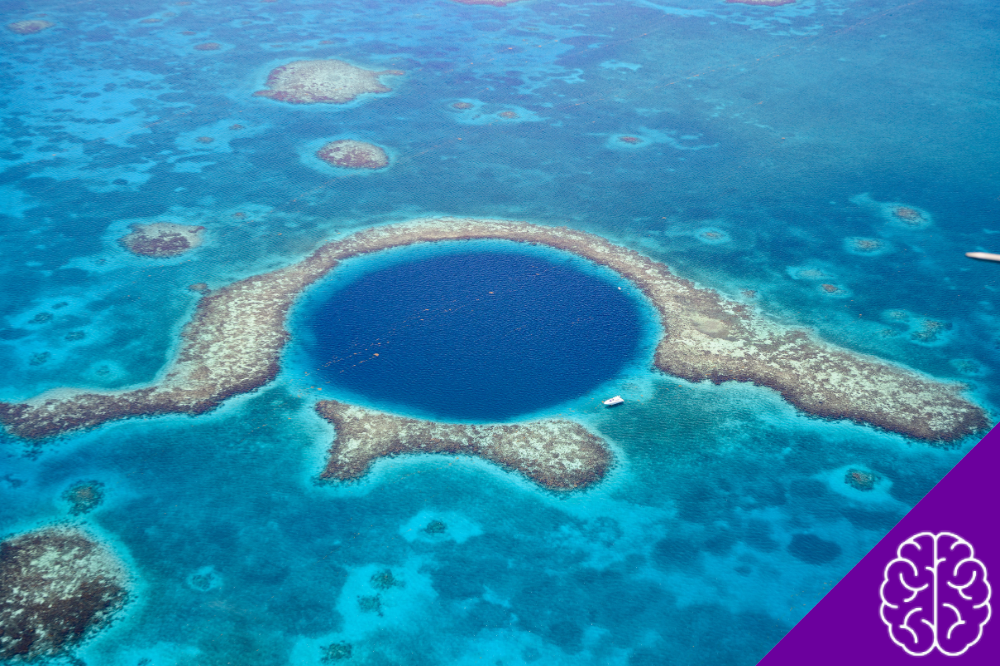
From above, the Great Blue Hole looks like a dark circle cut into the bright turquoise waters of the Caribbean. Its almost perfect shape and unusual depth have made it one of the most recognizable natural features in the ocean.
But the real story lies below the surface. Beneath that blue opening are ancient cave formations, steep limestone walls, layers of water with very different conditions and a geological record that helps scientists understand how the landscape changed over thousands of years.
Where is the Great Blue Hole located?
The Great Blue Hole sits near the center of Lighthouse Reef Atoll, approximately 50 miles (80 kilometers) off the coast of mainland Belize. It forms part of the Belize Barrier Reef Reserve System, a protected marine area that UNESCO recognizes as a World Heritage Site.
The sinkhole measures roughly 1,000 feet (300 meters) across and 410 feet (125 meters) deep. Its dark center contrasts sharply with the shallow turquoise water surrounding it. That difference comes from depth: sunlight reaches the pale reef and sandy bottom around the hole, while much less light penetrates its deeper interior.
Lighthouse Reef is also part of the larger Mesoamerican Reef system, which stretches along the coasts of Mexico, Belize, Guatemala and Honduras. The surrounding ecosystem supports a wide variety of marine species, making the location important beyond its striking appearance.
How did this giant ocean sinkhole form?
The Great Blue Hole did not begin as an underwater feature. It developed as a limestone cave system when sea levels were much lower, during the last Ice Age.
At that time, the area that now sits beneath the Caribbean consisted of exposed land. Rainwater gradually dissolved the limestone, creating underground passages and large chambers. Over long periods, water movement and erosion expanded these cavities.
As the Ice Age ended, global temperatures rose and glaciers melted. Sea levels climbed, flooding the cave system. Parts of the cave ceiling eventually collapsed, leaving the large circular opening visible today.
Scientists can identify evidence of this earlier landscape inside the hole. Its walls contain stalactites and other mineral formations that could only have developed when the caves were above water. These structures provide physical clues about the region’s geological past.
What can you find inside the Great Blue Hole?
The interior is more than a deep vertical drop. It contains several features that reveal how the original cave system developed and changed.
Ancient stalactites and stalagmites
One of the most remarkable discoveries is the presence of enormous stalactites hanging from the limestone walls. These mineral formations grow as water carrying dissolved minerals slowly drips through cave ceilings. Stalagmites form on the ground below, where mineral deposits accumulate.
Their presence underwater is significant because these structures formed when the cave was dry. Their position and shape help researchers understand the conditions that existed before rising sea levels flooded the area.
Steep limestone walls and overhangs
The walls descend sharply from the opening, creating a cavern-like environment. Some sections feature overhanging rock shelves and irregular surfaces left by the collapse of the original cave structure.
Sediment at the bottom
At the deepest point, fine sediment has accumulated over thousands of years. These deposits interest researchers because they preserve information about environmental changes, including past storms and shifts in climate.
Together, these features make the Great Blue Hole a valuable natural archive, not simply a destination for underwater exploration.
Why is the water at the bottom so different?
One of the most surprising characteristics of the sinkhole is the way its water changes with depth.
Sunlight becomes increasingly limited as divers descend. Temperature, water movement and oxygen levels also vary throughout the water column. Scientific studies have found that conditions below approximately 300 feet (90 meters) become anoxic, meaning the water contains little to no dissolved oxygen.
Researchers have also identified a layer containing hydrogen sulfide in the deeper water. This compound can form when microorganisms break down organic matter in environments with little oxygen. It contributes to the unusual chemical conditions near the bottom.
These conditions make the deepest sections difficult environments for most marine animals. Unlike the shallow reef around the opening, the lower interior cannot support the same abundance of life.
What marine life lives around the sinkhole?
Although the deepest sections support limited life, the surrounding reef is far from empty. Its shallow waters provide habitat for coral, reef fish and larger marine animals.
Divers may encounter:
- Caribbean reef sharks: These sharks sometimes swim around the sinkhole and are among the most recognizable animals associated with the site.
- Nurse sharks: Often found resting near reefs and sandy areas.
- Groupers: Large reef fish that use rocky formations and coral structures for shelter.
- Other reef fish: Numerous species inhabit the coral formations surrounding the opening.
Most marine activity takes place near the rim, where sunlight and access to food support a more diverse ecosystem. The contrast between these shallow habitats and the deep interior makes the surrounding reef especially interesting to explore.
What have scientists and explorers discovered?
The Great Blue Hole became internationally famous after ocean explorer Jacques Cousteau visited the site in 1971 aboard the research vessel Calypso. His expedition helped introduce the formation to a global audience and encouraged further underwater investigation.
Since then, divers and researchers have studied its geology, depth and unusual water conditions. Recreational scuba divers can explore part of the vertical walls and observe some of the ancient formations, although reaching the deepest sections requires specialized equipment.
In December 2018, an expedition using submersibles explored the sinkhole’s deeper interior and collected detailed sonar information. This technology allowed researchers to examine areas that ordinary scuba divers cannot safely reach.
Scientific research has also focused on sediment deposits at the bottom. These layers can preserve evidence of past environmental events, offering information that goes beyond the formation itself.
The discoveries have helped scientists examine how geological processes and changing sea levels shaped the region over time.
Can you explore the Great Blue Hole?
Visitors can experience the site through scuba diving, boat excursions and aerial tours. Each option offers a different perspective.
Scuba diving provides a closer look at the limestone walls and submerged formations. However, the depth and diving conditions make this an experience better suited to certified and experienced divers. Recreational dives generally remain within established depth limits rather than reaching the bottom.
Aerial tours offer a view of the entire circular formation. From above, the contrast between the dark center and bright reef becomes especially clear, making it easier to appreciate the sinkhole’s scale.
Visitors who prefer to stay near the surface can also explore the surrounding reef through snorkeling excursions, depending on the tour and local conditions.
The Great Blue Hole is part of a protected marine environment, so responsible tourism matters. Choosing licensed operators and following local conservation guidelines helps reduce pressure on the reef and its wildlife.
A Window Into an Ancient Underwater World
The Great Blue Hole is remarkable not only because of its size, but because it preserves evidence of a landscape that existed before rising sea levels transformed the region. Its limestone formations, deep water layers and sediment deposits reveal a history that cannot be understood from the surface alone.
What looks like a simple dark circle in the Caribbean is actually a complex geological structure. And although explorers have already uncovered many of its secrets, the sinkhole remains an important place for studying how oceans, caves and coastal environments change over time.