

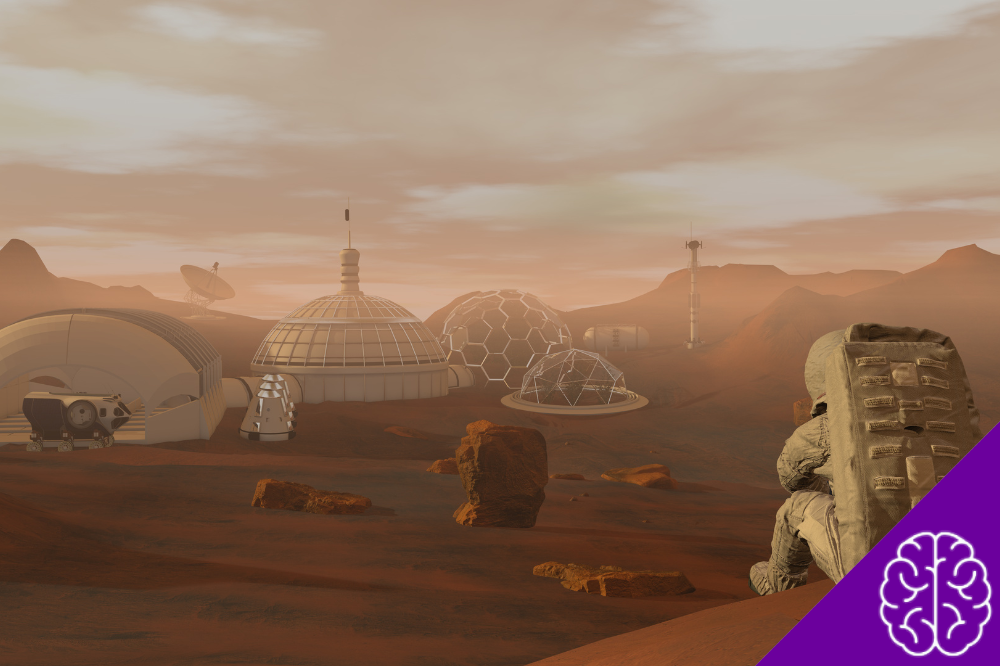
The dream of establishing a permanent presence on the Red Planet has moved from the pages of science fiction to the drafting tables of space agencies and private aerospace firms. While the visual of a gleaming metallic city under a pink sky is popular, the physical reality of a human colony on Mars must solve the most extreme environmental challenges our species has ever faced.
From the necessity of subterranean living to the complex chemistry of breathing an alien atmosphere, every aspect of Martian life relies on precision engineering. This colony will not look like a traditional terrestrial city; instead, it will function as a highly integrated, biological, and mechanical life-support system designed to keep humans alive in a vacuum.
The Shielded Subterranean Architecture
The most striking feature of a human colony on Mars will likely be its invisibility from the surface. Mars lacks a thick atmosphere and a global magnetic field, leaving its surface exposed to lethal levels of solar and cosmic radiation. To protect inhabitants, official architectural concepts from NASA and private designers prioritize subterranean or shielded structures.
Colonists will likely repurpose natural lava tubes—vast underground caverns formed by ancient volcanic activity—as ready-made shelters. These geological features provide a thick basaltic barrier against radiation and micrometeoroids. Inside these tubes, pressurized inflatable habitats house living quarters, laboratories, and communal spaces, creating a safe, climate-controlled environment beneath the Martian crust.
- Lava tubes offer natural insulation and radiation protection.
- 3D-printed habitats utilize Martian regolith (soil) as a primary building material.
- Subsurface living minimizes the energy required for thermal regulation.
- Vertical shafts provide controlled entry points and emergency exits.
Living in Regolith-Printed Domes
Where surface structures exist, builders will not use glass or traditional steel. Robotic missions will likely arrive years before humans to 3D-print structures using “Martian concrete,” a mixture of local regolith and a binding agent. These thick-walled domes feature a distinct, layered texture, reflecting the robotic precision of their construction.
The color of the colony blends perfectly with the landscape, as the building material is the Martian soil itself. These domes must withstand the massive pressure differential between a pressurized interior and the thin, near-vacuum exterior. Small, reinforced windows made of specialized transparent aluminum or thick silica glass provide limited views, though high-definition camera arrays handle most external monitoring.
The Life-Support Core: Scrubber and Recyclers
Every human colony on Mars functions as a closed-loop system. On Earth, we rely on a massive biosphere to recycle our air and water, but on Mars, mechanical systems must perform these tasks with 100% efficiency. The Environmental Control and Life Support System (ECLSS) forms the heart of the colony.
Large-scale “scrubbers” constantly pull the 95% carbon dioxide atmosphere from the outside and convert it into breathable oxygen through electrolysis and Sabatier reactions. Water is equally precious. The system captures, purifies, and returns every drop of moisture—from sweat to wastewater. Exposed piping and monitoring panels define the aesthetic of a Martian home, as every resident must remain aware of the life-giving machinery surrounding them.
The Martian Greenhouse: Vertical Farming
Food sustainability represents the ultimate hurdle for a permanent human colony on Mars. Shipping supplies from Earth is prohibitively expensive and logistically risky. Therefore, hydroponic and aeroponic greenhouses occupy a large portion of the colony’s footprint.
These farms utilize vertical stacking to maximize space and LED lighting tuned to specific wavelengths to accelerate growth. Instead of traditional soil, plants grow in nutrient-rich mists or water. These “green zones” serve a dual purpose: they provide fresh produce, such as kale, sweet potatoes, and legumes, while acting as a biological backup for oxygen production and psychological relief for colonists.
- Hydroponic systems eliminate the need for heavy terrestrial soil.
- Vertical farming maximizes caloric output per square meter.
- Plant life provides essential “biophilia” to improve mental health.
- Genetically modified crops thrive in lower gravity.
Martian Industry: In-Situ Resource Utilization
A colony that relies entirely on Earth is merely an outpost. To become a true colony, it must practice In-Situ Resource Utilization (ISRU). The visual landscape of the colony features massive industrial arrays designed to extract water ice from the subsurface and perchlorates from the soil.
Water ice, once harvested, provides drinking water, oxygen, and hydrogen for rocket fuel. Engineers will likely place this industrial sector several hundred meters from the living quarters to minimize noise and the risk of industrial accidents. Robotic rovers and automated mining equipment operate as constant fixtures, moving between extraction sites and the central processing hubs.
The Psychological Layout: Creating “Home”
The interior of a human colony on Mars must address the psychological toll of isolation. Design concepts prioritize “soft” interior elements to contrast with the hard, metallic exterior. Adjustable lighting mimics the Earth’s 24-hour cycle to maintain circadian rhythms, as a Martian day (a “sol”) lasts about 40 minutes longer than an Earth day.
Communal spaces encourage social interaction, preventing the “bunker mentality” that can arise in confined environments. High-bandwidth communication with Earth—though delayed by 3 to 22 minutes—allows for digital connection, but the physical environment must provide enough variety in color, texture, and acoustics to keep the human mind healthy.
Powering the Red Planet: Nuclear and Solar
The energy requirements for a human colony on Mars are staggering. While solar arrays remain a visible component, massive dust storms can shroud the planet for months, making them vulnerable. Therefore, the colony will likely rely on small, modular nuclear reactors, such as NASA’s Kilopower technology.
These reactors provide a constant, reliable power source regardless of light levels or weather. Operators place them in remote areas, shielded by distance and Martian topography. On the surface, vast fields of solar panels complement the nuclear core, providing peak power during the day and serving as a backup system.
- Modular nuclear reactors provide consistent power during global dust storms.
- Solar arrays use dust-repelling technology to maintain efficiency.
- Battery storage arrays occupy large subterranean chambers.
- Redundant power grids connect every life-critical system.
The Reality of Martian Gravity
Living in 38% of Earth’s gravity fundamentally changes how engineers build a human colony on Mars. Stairs can be steeper, ceilings can be higher, and furniture can be lighter. However, the physiological impact on the human body—bone density loss and muscle atrophy—demands dedicated fitness centers.
Every colony features a large gym where residents spend several hours a day using resistance machines and centrifuges to simulate Earth’s gravity. These areas are not just amenities; they are medical necessities for survival. The colony’s design integrates movement and physical load into daily life to ensure colonists can survive the transition back to higher gravity if they ever return to Earth.
The Evolution of a Multi-Planetary Society
The final look of a human colony on Mars combines extreme utility and hidden beauty. It is a place where biology and technology merge to create a tiny bubble of life in a sterile universe. As the colony grows, survival-focused modules will transition into expansive, permanent cities, eventually reflecting a unique Martian culture.
Success on Mars depends on the ability to respect the harsh environment while meticulously managing every gram of resource. From the oxygen in the tanks to the water in the pipes, life on Mars stands as a testament to human will. The colony is not just a building; it is a living organism, breathing and growing on the frontier of the solar system.