

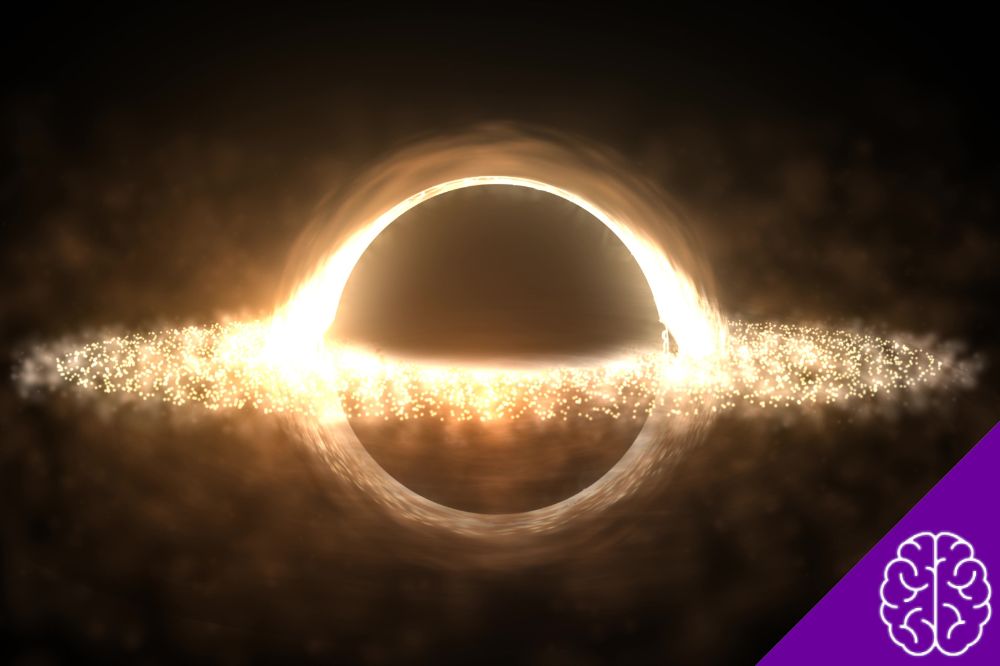
The idea of time near a black hole sounds like something out of science fiction. However, according to modern physics, time really does behave differently in extremely strong gravitational environments. Near a black hole, the passage of time slows down dramatically compared with how time moves for observers far away.
This phenomenon is known as gravitational time dilation, a prediction of Einstein’s theory of general relativity. It means that gravity doesn’t just affect objects and light—it also affects time itself.
Understanding what happens to time near a black hole offers insight into some of the most extreme conditions in the universe and reveals how space, gravity, and time are deeply connected.
Why Gravity Affects Time
To understand time near a black hole, it helps to start with one of the key ideas from general relativity: gravity is not simply a force pulling objects together. Instead, massive objects bend the fabric of space and time.
The stronger the gravitational field, the more space-time becomes distorted.
This distortion has measurable effects. One of them is that clocks closer to a massive object run more slowly compared with clocks located farther away. On Earth the effect is extremely small, but around very massive objects—like neutron stars or black holes—the difference becomes dramatic.
Near a black hole, gravity is so intense that the slowing of time becomes extreme.
What Is Gravitational Time Dilation?
Gravitational time dilation describes how time moves more slowly in stronger gravitational fields.
In simple terms, if two observers are measuring time in different gravitational environments, they may not agree on how much time has passed.
One observer close to a black hole might experience minutes or hours, while an observer far away might measure years passing.
This effect becomes stronger as an object approaches the black hole’s boundary, known as the event horizon.
Scientists describe gravitational time dilation using an equation derived from general relativity:
t′ = t / √(1 − (2GM / rc²))
In this equation, the variables represent:
- t: time experienced by a distant observer
- t′: time experienced closer to the massive object
- G: gravitational constant
- M: mass of the object
- r: distance from the center of mass
- c: speed of light
As the distance r becomes smaller—meaning the observer moves closer to the black hole—the denominator approaches zero. This causes time to slow dramatically relative to an outside observer.
What Happens at the Event Horizon?
The event horizon is the boundary surrounding a black hole. Once something crosses this boundary, it cannot escape the black hole’s gravity—not even light.
For someone observing from far away, time near a black hole appears to behave in a very unusual way.
As an object approaches the event horizon:
- its movement appears to slow down
- light from the object becomes increasingly redshifted
- the object appears to freeze near the horizon
From the perspective of the distant observer, it may look as though the object never actually crosses the event horizon.
However, the experience is different for the object falling into the black hole.
What an Astronaut Would Experience
If an astronaut were falling toward a black hole, their own experience of time near a black hole would feel normal—at least initially.
Their clock would tick at a regular pace from their own perspective. They would not feel time slowing down directly.
However, something strange would happen when looking back toward the rest of the universe. The astronaut would see distant events occurring faster than normal. In theory, they might observe the outside universe evolving rapidly as they approach the event horizon.
This difference in perspective illustrates one of the key ideas of relativity: measurements of time depend on the observer’s frame of reference.
Extreme Effects Close to a Black Hole
Black holes create some of the most extreme environments known in astrophysics. As objects approach them, several dramatic effects occur alongside changes in time near a black hole.
These include:
- gravitational redshift, where light loses energy and shifts toward longer wavelengths
- spaghettification, where tidal forces stretch objects along the direction of gravity
- orbital distortion, where nearby objects follow curved paths through warped space-time
These effects become especially intense close to the event horizon of smaller black holes.
Evidence That Time Really Slows Near Massive Objects
The idea that time near a black hole slows down might sound purely theoretical, but the underlying concept of gravitational time dilation has been experimentally verified.
Scientists have observed time dilation effects in several contexts:
- atomic clocks run slightly faster at higher altitudes on Earth
- clocks on satellites experience different time rates than those on the ground
- GPS systems must account for relativistic time effects to remain accurate
Although these measurements occur in much weaker gravitational fields than those near a black hole, they confirm that gravity truly affects time.
Why This Matters for Understanding the Universe
Studying time near a black hole helps physicists explore the limits of current theories about gravity, space, and time.
Black holes provide natural laboratories for testing extreme physics. They allow researchers to investigate how general relativity behaves in the strongest gravitational fields known.
These studies also raise deeper questions about how gravity interacts with quantum mechanics—one of the biggest unsolved problems in modern physics.
A Universe Where Time Isn’t Absolute
One of the most fascinating insights from modern physics is that time is not universal or absolute.
The behavior of time near a black hole demonstrates that time depends on gravity, motion, and the observer’s position in space. What appears to be seconds for one observer may correspond to years for another.
While black holes represent the most dramatic example of this effect, the principle applies everywhere in the universe.
Understanding these ideas challenges our everyday intuition but also reveals how complex and fascinating the structure of the universe truly is.