

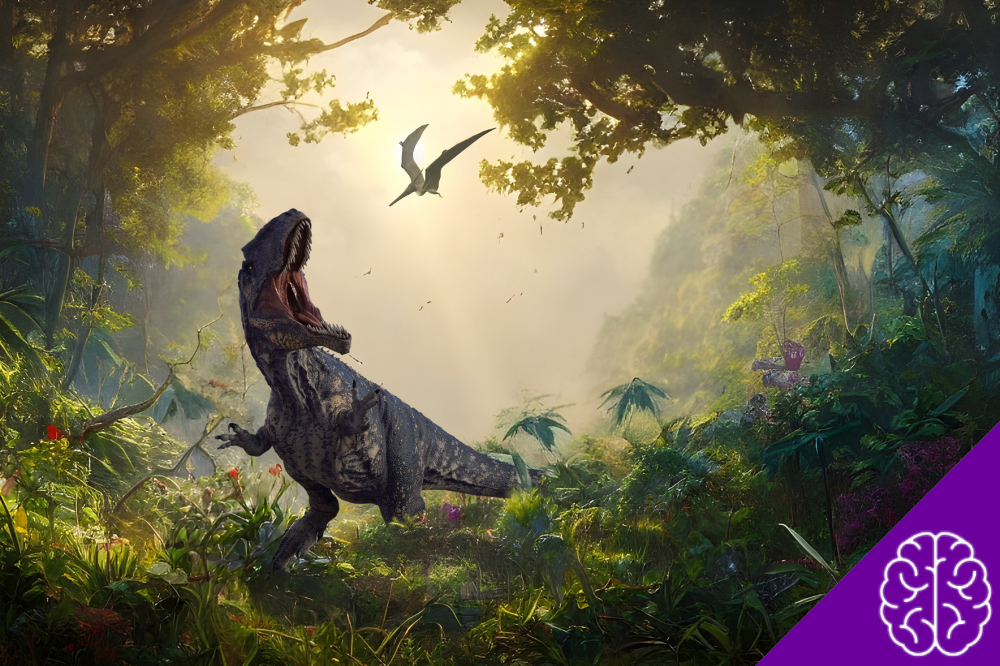
The history of life on Earth is defined by a single, catastrophic moment 66 million years ago. A massive asteroid, roughly six miles wide, slammed into the Yucatan Peninsula, triggering a chain of events that wiped out 75% of all species. But what if that cosmic rock had missed? What if dinosaurs never extinct, and the “Age of Reptiles” had simply continued into the present day?
Speculating about a world where dinosaurs never extinct is not just for science fiction movies. It is a serious exercise in evolutionary biology. By looking at how animals adapt to their environments, we can imagine a version of 2026 where the skyline isn’t dominated by skyscrapers, but by the towering necks of sauropods, and where the predators in the grass are much more formidable than a common wolf or lion.
1. The Evolution of the “Dinosauroids”
If dinosaurs never extinct, they wouldn’t look exactly like the ones we see in museums today. Evolution never stops. Over 66 million years, dinosaurs would have continued to change to meet the challenges of a shifting climate.
Brains over Brawn
Some paleontologists have speculated that certain small, upright predators like the Stenonychosaurus—which already had large brains and stereo vision—might have evolved higher intelligence. These “Dinosauroids” might have developed social structures, complex communication, or even basic tool use. While they wouldn’t necessarily look like humans, they might have filled the same “intelligent niche” that we occupy today.
Adapting to the Cold
The Earth has gone through several ice ages since the dinosaurs lived. If dinosaurs never extinct, we would likely see “woolly” versions of our favorite reptiles. We already know many dinosaurs had feathers; in a colder world, these feathers would have become thick, insulating coats, allowing Tyrannosaurs to hunt in the snow and Triceratops to migrate across frozen tundras.
2. Would Humans Ever Exist?
This is the most humbling part of the “what if” scenario. If dinosaurs never extinct, it is highly unlikely that humans—or any large mammals—would have ever evolved.
Mammals in the Shadows
During the time of the dinosaurs, our ancestors were tiny, shrew-like creatures scurrying in the dark. They stayed small because the “large animal” spots in the ecosystem were already taken. Without the extinction event to clear the stage, mammals might have stayed small forever.
There would be no horses, no elephants, and certainly no upright-walking apes. The world would belong to the scales and feathers, and the dominant life forms would be those that could survive in a world where a five-ton predator is always around the corner.
3. A Very Different Geography
The movement of the continents and the growth of forests were deeply affected by the animals living on them. Sauropods, the long-necked giants, were like living bulldozers. They knocked down trees and cleared massive paths through forests.
If these dinosaurs never extinct, the thick, closed-canopy rainforests we know today might not exist. Instead, the Earth might be covered in vast, open grasslands and “park-like” forests maintained by the constant grazing of massive dinosaur herds. The very landscape of the planet would be shaped by the footsteps of giants.
4. The Impact on Today’s Animals
The animals we love today—birds, crocodiles, and lizards—are the “leftover” dinosaurs or their close relatives. If the big dinosaurs never extinct, these smaller relatives would have faced much tougher competition.
- Birds: Since birds are technically avian dinosaurs, they would likely still exist, but they might have stayed smaller or more specialized to stay out of the way of larger flying reptiles like Pterosaurs.
- Modern Predators: Our lions, tigers, and bears would have no place in a world with feathered raptors. A raptor is faster, has sharper claws, and is often more efficient at hunting in groups. The mammalian predators we fear today would likely have been the prey in a dinosaur-dominated world.
5. Dinosaurs in the Modern Climate
One of the biggest challenges for dinosaurs if they had survived to the present would be the modern climate. The world of the Cretaceous was much warmer and had higher oxygen levels than our world in 2026.
Surviving the Modern World
Dinosaurs were incredibly adaptable. We see this in how birds survive everywhere from the Sahara to Antarctica. If dinosaurs never extinct, they would have had to adapt to lower oxygen levels by developing even more efficient lungs. They would also have had to survive the rise of flowering plants and grasses, which didn’t exist for much of their early history.
It is possible that the dinosaurs of 2026 would be smaller on average than their ancient ancestors, as smaller bodies are often easier to maintain in environments with less abundant food or lower oxygen.
6. How We Can Explore This for Free
While we can’t visit a world where dinosaurs never extinct, modern technology allows us to visualize it better than ever before. Scientific organizations and museums provide incredible resources that are free for the public:
- Digital Reconstructions: Websites like those from the Smithsonian or the Natural History Museum offer 3D models of how dinosaurs likely looked and moved.
- Open-Source Journals: You can read the latest paleontological discoveries for free on sites like PLOS ONE, which often features “speculative biology” papers about dinosaur evolution.
- Live Webcams: Watching “modern dinosaurs” like crocodiles or birds through free zoo webcams can give us a glimpse into the behaviors that ancient giants might have shared.
The Ultimate “What If” Legacy
Thinking about a world where dinosaurs never extinct reminds us how much of our own existence is due to pure, cosmic luck. We are here because a rock hit the Earth at exactly the right time to give our tiny mammalian ancestors a chance to breathe.
If that asteroid had passed by even a few thousand miles away, the history of Earth would have stayed on its reptilian path. There would be no cities, no internet, and no one to write or read this article. Instead, the world would be a wild, prehistoric paradise, filled with the sounds of trumpeting giants and the shadows of great predators.
It is a fascinating reminder that Earth is a planet of constant change, and that the “Age of Humans” is just a tiny chapter in a much longer story that almost ended before it began.