

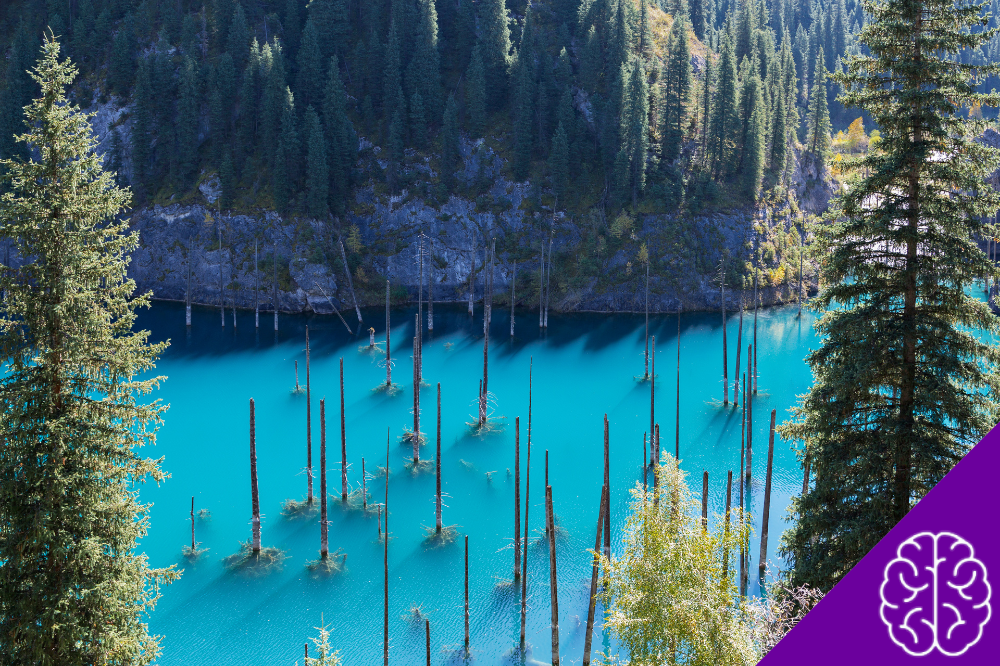
Some deadly lakes appear calm, beautiful, and completely harmless. Yet beneath their surfaces, hidden geological processes can create conditions capable of killing animals and humans within minutes.
Although these lakes are extremely rare, they represent one of the most unusual natural hazards on Earth. In certain circumstances, massive amounts of toxic gas can accumulate underwater and be released suddenly, transforming an ordinary-looking lake into a deadly environment overnight.
What makes a lake deadly?
Most lakes pose little danger beyond common risks such as drowning, storms, or contamination.
A small number of lakes, however, sit above volcanic regions where carbon dioxide and other gases seep upward from deep underground. Over time, these gases can dissolve into the lake’s deeper layers.
Normally, the water remains stable and traps the gas below the surface. The danger arises when that stability is disrupted.
If enough gas escapes at once, it can form a dense cloud capable of spreading across nearby communities.
The phenomenon known as a limnic eruption
Scientists use the term “limnic eruption” to describe a sudden release of dissolved gases from a lake.
The process can be compared to opening a shaken bottle of carbonated soda.
As pressure changes, dissolved gas rapidly escapes from the water. In a lake, however, the scale can be enormous.
A limnic eruption may release:
- Massive quantities of carbon dioxide;
- Smaller amounts of other volcanic gases;
- Dense clouds that remain close to the ground;
- Oxygen-displacing gas capable of causing suffocation.
Because carbon dioxide is heavier than air, it can flow through valleys and low-lying areas before dispersing.
Lake Nyos: the disaster that shocked the world
The most famous example occurred at Lake Nyos in 1986.
On the night of August 21, a huge volume of carbon dioxide suddenly erupted from the lake.
The gas cloud moved silently through nearby villages, displacing oxygen in the air. Thousands of animals died, and more than 1,700 people lost their lives.
What made the event particularly frightening was the lack of warning signs. Many victims never realized what was happening.
The disaster remains one of the deadliest natural gas releases ever recorded.
Why did Lake Nyos become so dangerous?
Several factors combined to create the catastrophe.
Scientists believe that:
- Carbon dioxide had accumulated for years in deep water;
- The lake sits within a volcanic region;
- Deep water contained unusually high gas concentrations;
- A triggering event disturbed the lake’s stability.
The exact trigger remains debated, but possibilities include landslides, small earthquakes, or natural mixing within the lake.
Once the gas began escaping, a chain reaction rapidly released even more carbon dioxide.
Another deadly example: Lake Monoun
Two years before the Lake Nyos disaster, a similar event occurred at Lake Monoun.
In 1984, a sudden gas release killed dozens of people living nearby.
At the time, scientists were still trying to understand what had happened.
The tragedy later proved crucial because it helped researchers identify the mechanisms behind limnic eruptions and better understand the risks posed by certain volcanic lakes.
How common are deadly lakes?
Fortunately, these events are extremely rare.
Only a small number of lakes worldwide possess the combination of geological and chemical conditions required for a limnic eruption.
Researchers pay particular attention to lakes that have:
- Great depth;
- Volcanic activity beneath them;
- High concentrations of dissolved gas;
- Limited natural water mixing.
Most lakes do not meet these conditions and therefore pose no similar threat.
How scientists reduce the risk today
Following the Lake Nyos disaster, engineers and scientists developed methods to prevent dangerous gas accumulation.
One of the most effective solutions involves degassing systems.
These systems use pipes that extend into deep water and gradually release carbon dioxide in controlled amounts.
The process helps prevent pressure from building to dangerous levels.
Today, degassing projects operate at several high-risk lakes and have significantly reduced the chances of another large-scale eruption.
Are there other dangerous lakes in the world?
Not all hazardous lakes are dangerous for the same reason.
Some contain:
- Extremely acidic water;
- Toxic volcanic chemicals;
- High levels of dissolved gases;
- Dangerous microorganisms.
For example, Lake Kivu contains enormous quantities of dissolved carbon dioxide and methane. Although it has not experienced a disaster on the scale of Lake Nyos, scientists continue to monitor it closely because of its unique geological characteristics.
Its size and nearby population make ongoing observation particularly important.
Could a deadly lake form elsewhere?
In theory, yes. Where volcanic activity, deep water, and gas accumulation occur together, similar conditions could develop.
However, modern monitoring systems have greatly improved scientists’ ability to identify potential risks before they become catastrophic.
Many lakes located in volcanic regions are now regularly studied for changes in gas concentrations, water chemistry, and geological activity.
Why deadly lakes fascinate scientists
Few natural hazards are as unusual as a lake capable of releasing a lethal cloud without warning.
Unlike earthquakes, hurricanes, or volcanic eruptions, the danger remains hidden beneath the surface, sometimes for decades. This combination of rarity, mystery, and destructive potential continues to make these events a major area of scientific research.
The most remarkable deadly lakes are reminders that even seemingly peaceful landscapes can conceal powerful geological forces. Thanks to decades of research, scientists now understand these lakes far better than they did in the past, helping reduce the risk of future tragedies while revealing one of nature’s most extraordinary phenomena.