

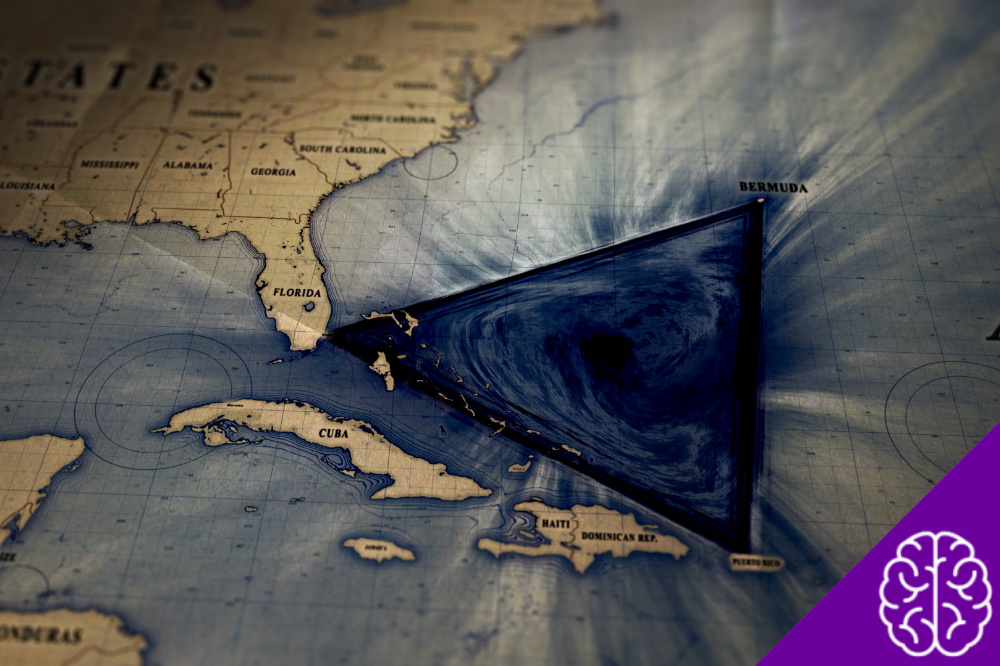
The Bermuda Triangle is one of the most famous mysteries in the Atlantic. Stories of missing ships, vanished aircraft and strange phenomena have turned a large area of ocean into the center of countless theories.
But how much of that story is supported by evidence? Historical records, naval investigations and oceanographic information reveal a more complicated picture than the legend suggests.
Where Is the Bermuda Triangle?
The Bermuda Triangle generally refers to an area of the western North Atlantic roughly associated with Florida, Bermuda and Puerto Rico.
There is one important detail: the area has no officially defined boundaries. The U.S. Board on Geographic Names does not recognize “Bermuda Triangle” as an official geographic name.
That makes some claims about the number of disappearances difficult to evaluate. Different writers have used different boundaries, meaning that the incidents included in one version of the Triangle may not appear in another.
The name came later
The disappearances did not happen because someone first identified a mysterious triangle on a map.
Several famous incidents occurred before the term became popular. Writer Vincent Gaddis helped establish the name in 1964 through an article in Argosy magazine. Later books and articles connected older disappearances to the same area and helped create the modern legend.
That distinction becomes important when looking at the cases themselves.
Two Disappearances That Built the Legend
Some incidents associated with the Triangle are genuinely remarkable. Two in particular became central to the story.
Flight 19 — December 5, 1945
Five U.S. Navy TBM Avenger aircraft left Fort Lauderdale, Florida, for a routine navigation and bombing training mission over the Bahamas.
14 men were aboard the five aircraft.
The mission initially went as planned. Later communications indicated that the pilots were having difficulty determining their position. The aircraft never returned.
A rescue aircraft was then sent to search for them.
That aircraft, a PBM Mariner carrying 13 people, also disappeared. The Navy later considered an in-flight fire a likely explanation for the Mariner’s loss.
Despite a major search operation, no confirmed trace of the five Avengers was found.
What remains unknown?
The exact fate of Flight 19 has never been established. Official naval records document navigation problems and other circumstances surrounding the flight, but they do not provide a definitive explanation for the loss.
USS Cyclops — March 1918
More than two decades earlier, the USS Cyclops disappeared while carrying manganese ore toward Baltimore.
People aboard: 306
Distress call: none
Confirmed wreckage: none
The ship’s disappearance initially raised suspicions of enemy action during World War I. Later investigations found no evidence that a German submarine or raider had caused the loss. The Naval History and Heritage Command identifies catastrophic structural failure as the most likely explanation discussed in its historical account.
The Cyclops disappeared long before the phrase “Bermuda Triangle” became popular. Its inclusion in the legend came later.
What Makes the Area Challenging for Ships and Aircraft?
There are real environmental and navigational factors in the region.
NOAA points to several possibilities that can contribute to maritime accidents:
- Tropical storms and hurricanes
- Sudden changes in weather
- The Gulf Stream
- Shallow waters in parts of the Caribbean
- Navigation and human error
The Gulf Stream is particularly relevant because it can move quickly and influence local sea conditions. Severe weather can also develop rapidly in the western North Atlantic.
None of these factors explains every disappearance. They do show that ships and aircraft operating in the area face ordinary hazards that can become serious under the wrong circumstances.
And what about compasses?
This part of the legend contains a small piece of real navigation science.
Magnetic north and geographic north are not always in the same place. Depending on location, a compass can therefore require corrections when navigators determine a true course.
NOAA notes that there are locations in the region where a compass can point toward true north rather than magnetic north.
That does not mean compasses mysteriously malfunction in the Triangle.
It means navigators need to understand magnetic variation and use the appropriate heading information.
What About Atlantis, Methane and UFOs?
The most dramatic explanations came later.
Among the theories associated with the Bermuda Triangle are:
Methane releases
Some accounts suggest gases from the seafloor could reduce water density and cause ships to sink. Methane does exist naturally in marine environments, but that fact alone does not establish it as the cause of a particular disappearance.
Electromagnetic anomalies
Some theories attribute navigation problems to unusual magnetic or electromagnetic forces. There is no established evidence showing that such a phenomenon causes vessels or aircraft to disappear in the region.
Atlantis and UFOs
Other versions of the story involve the lost civilization of Atlantis, extraterrestrial activity or other supernatural explanations.
NOAA discusses several of these ideas as theories rather than established causes.
The key issue is evidence.
A phenomenon can be real without explaining a particular accident. To establish a cause, investigators would need evidence connecting that phenomenon to the specific disappearance.
Does the Bermuda Triangle Actually Have More Disappearances?
This is one of the most important claims behind the legend.
According to NOAA, there is no evidence that mysterious disappearances occur more frequently in the Bermuda Triangle than in other large, well-traveled areas of the ocean.
That does not mean every historical disappearance has a known explanation.
Instead, two different statements need to be kept separate:
“We don’t know exactly what happened.”
and
“Something unusual caused it.”
The first can be supported by an incomplete investigation. The second requires additional evidence.
The U.S. Naval History and Heritage Command similarly describes the idea that ships and aircraft are more likely to disappear in the Triangle than elsewhere as debunked.
Why Do the Stories Still Sound So Mysterious?
Part of the answer is the ocean itself.
When an aircraft or ship disappears at sea, investigators may have to search an enormous area. Strong currents can move debris away from the original location, while deep water can make wreckage extremely difficult to find.
That creates a particular problem for historical cases:
less physical evidence means more uncertainty.
Flight 19 illustrates this perfectly. The aircraft disappeared in 1945, and no confirmed wreckage from the five Avengers was recovered. That left unanswered questions that later writers could fill with increasingly dramatic explanations.
The legend then connected separate incidents and presented them as evidence of one phenomenon.
Fact vs. Fiction
Here is the simplest way to separate the historical record from the mythology.
What is documented?
- Flight 19 disappeared during a 1945 U.S. Navy training mission.
- A rescue aircraft disappeared while searching for Flight 19.
- The USS Cyclops disappeared in 1918 with 306 people aboard.
- Some disappearances in the broader region remain unexplained.
- The area experiences storms, changing weather and challenging sea conditions.
- Navigation errors can contribute to accidents.
What has not been established?
- A supernatural force causes ships or aircraft to disappear.
- UFOs are responsible for the missing aircraft.
- Atlantis is connected to the disappearances.
- Compasses mysteriously stop working throughout the region.
- The area has an unusually high rate of unexplained disappearances.
The difference is important: the tragedies are historical; the extraordinary explanations require evidence that has not been established.
Why the Mystery Endures
The Bermuda Triangle became powerful as a story because it combines several elements that naturally attract attention: disappearances, missing wreckage, dramatic historical events and unanswered questions.
The name also helped transform separate incidents into a single narrative. Flight 19 and the USS Cyclops occurred decades apart and under very different circumstances, yet both later became major pieces of the same legend.
That does not make the original events less interesting.
It simply means the historical record and the mythology should be examined separately.
What the Evidence Really Tells Us
The Bermuda Triangle is a cultural legend built around real disappearances in a heavily traveled part of the Atlantic.
Some cases remain unresolved because investigators never recovered enough evidence to determine exactly what happened. Others have plausible explanations involving weather, navigation, mechanical problems or human error.
What the available evidence does not establish is a supernatural force or a unique phenomenon responsible for the area’s disappearances.
The most accurate answer is therefore also the simplest: the disappearances are real, but the extraordinary explanation remains unproven.