

Some hidden places on Earth look so unusual that they seem more like movie sets than real destinations. From underground cities and glowing caves to isolated islands and turquoise lagoons, these places show just how surprising the planet can be.
Some are hidden beneath the surface, while others are difficult to reach because of their remote locations. Here are 10 real destinations that prove you do not have to leave Earth to find landscapes that look almost impossible.
1. Derinkuyu Underground City, Turkey
What makes it unusual: An entire settlement exists beneath the surface.
Located in Cappadocia, Derinkuyu is an underground city carved into the region’s volcanic rock. It forms part of the Göreme National Park and the Rock Sites of Cappadocia, a UNESCO World Heritage site.
The underground complex is connected to a long history of subterranean settlements in the region. UNESCO describes Cappadocia as having underground towns such as Derinkuyu and Kaymaklı, along with rock-cut dwellings and villages.
Why it stands out:
From the surface, the landscape gives little indication of the extensive spaces beneath it.
2. Waitomo Glowworm Caves, New Zealand
What makes it unusual: The ceiling of an underground cave can look like a night sky.
The Waitomo Glowworm Caves are part of a large network of limestone caves in New Zealand’s Waikato region. Their most famous feature is the thousands of glowworms that create points of blue-green light across the darkness.
Visitors can travel through the cave by boat while looking up at the illuminated ceiling. New Zealand’s official tourism website describes the region as having more than 300 caves, formed in limestone by underground streams.
The surprising part
The glow comes from living organisms, not artificial lights. New Zealand’s tourism authority explains that the glowworms produce their bioluminescent light through a chemical reaction.
3. Socotra Island, Yemen
What makes it unusual: Its isolation has produced an extraordinary collection of endemic species.
The Socotra Archipelago lies in the Indian Ocean near the Horn of Africa. Its geographic isolation has helped create an ecosystem with many species that are not found elsewhere.
One of its most recognizable plants is the dragon’s blood tree, known for its distinctive umbrella-shaped crown. The species is also recognized as vulnerable on the IUCN Red List.
Look closely:
Socotra is not an undiscovered island. Its appeal comes from how different its landscape and biodiversity are from those found in more familiar destinations.
4. Hidden Lagoons of Baltinache, Chile
What makes it unusual: Bright turquoise lagoons sit in the middle of the Atacama Desert.
The Hidden Lagoons of Baltinache consist of seven turquoise pools surrounded by white saline formations in the Llano de la Paciencia.
According to Chile’s official tourism agency, the water has such a high salt concentration that visitors can float easily in the lagoons.
A striking contrast
The landscape combines:
- Turquoise water
- White salt formations
- Dry desert terrain
- Mountain scenery
Only some of the pools are available for bathing, while others are protected to preserve the formations.
5. Tepuis of Canaima National Park, Venezuela
What makes it unusual: Massive flat-topped mountains rise above the surrounding landscape.
The tepuis of Canaima National Park are among Venezuela’s most distinctive geological formations. UNESCO says roughly 65% of the park is covered by tepui formations.
These enormous table mountains have steep cliffs, waterfalls and isolated ecosystems. Canaima also contains Angel Falls, which UNESCO identifies as the world’s highest waterfall, with a drop of about 1,000 meters.
Why the landscape is so unusual:
The tepuis are not simply tall mountains. Their isolated, flat summits create geological and biological environments that differ from the areas around them.
6. Naica Crystal Cave, Mexico
What makes it unusual: Giant natural crystals fill a cave deep underground.
The Cave of Crystals is located beneath Naica Mountain in Chihuahua, Mexico. It contains enormous selenite crystals formed through hydrothermal processes.
According to the Naica project, some crystals reach approximately 12 meters in length and weigh up to 55 tons. The cave lies around 300 meters underground.
Why humans cannot simply explore it
The cave has extreme heat and humidity, making the environment dangerous for prolonged exposure.
That means this is one of those hidden places on Earth that is fascinating primarily because of what scientists have found there rather than because it functions as a conventional tourist attraction.
7. Danakil Depression, Ethiopia
What makes it unusual: Salt flats, volcanic activity and colorful mineral formations occupy an extreme environment.
The Danakil Depression lies in Ethiopia’s Afar region, near the meeting point of three tectonic plates.
The landscape includes:
- Vast salt flats
- Active volcanic features
- Geothermal areas
- Sulfur-rich formations
- The Dallol crater
Ethiopia’s official tourism authority describes much of the region as below sea level and highlights its intense geological activity.
The result is a landscape filled with colors and textures that can look almost artificial.
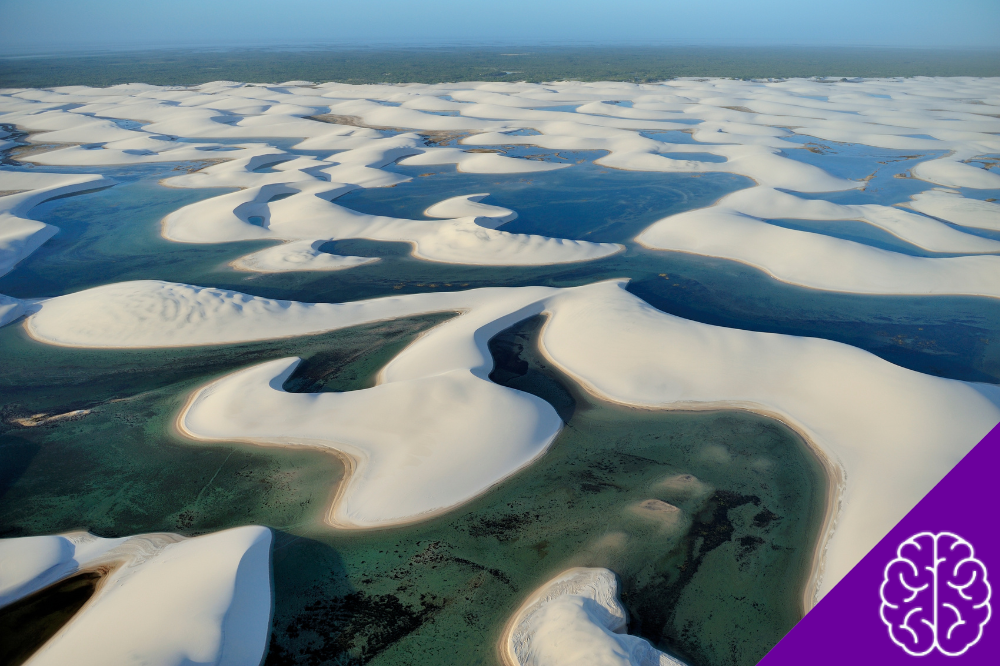
8. Lençóis Maranhenses, Brazil
What makes it unusual: It looks like a desert, but seasonal rain creates hundreds of temporary lagoons.
Lençóis Maranhenses National Park stretches across northeastern Brazil and is famous for its enormous white sand dunes.
During the rainy season, water collects in the depressions between the dunes, forming temporary lagoons.
Desert or not?
Despite its desert-like appearance, the area has a semi-humid climate. UNESCO explains that seasonal rainfall supplies the water responsible for the formation of the temporary inter-dunal lagoons. The park was added to the World Heritage List in 2024.
This unusual combination of dunes and seasonal water is what gives the landscape its distinctive appearance.
9. Svalbard Global Seed Vault, Norway
What makes it unusual: A global collection of crop seeds is stored inside an Arctic mountain.
The Svalbard Global Seed Vault sits on the remote Norwegian archipelago of Svalbard. Its purpose is to preserve seed samples from crop collections around the world.
The facility is built inside a mountain, using the natural conditions of the Arctic environment as an additional layer of protection.
One important detail:
This is not a conventional tourist attraction. The storage areas are restricted, although visitors can see the distinctive entrance from outside.
The concept may sound futuristic, but the purpose is practical: protecting agricultural biodiversity for the future.
10. Underwater Caves of the Turks and Caicos
What makes it unusual: A completely dark ecosystem exists beneath the Caribbean islands.
The Turks and Caicos Islands are better known for beaches and clear water, but researchers have also explored their flooded cave systems.
Smithsonian researchers investigated these underwater caves while studying unusual organisms, including a rare predatory scale worm. The scientists described the caves as extremely dark environments with ecosystems very different from those found in open water.
An ecosystem hidden below the water
These caves demonstrate how much of Earth’s biodiversity exists in environments that most people never encounter.
The contrast is especially striking: bright tropical waters at the surface give way to almost complete darkness below.
The Planet Still Has Plenty of Surprises
These hidden places on Earth show that extraordinary landscapes do not need myths, exaggeration or fictional stories to seem unbelievable.
Some are underground. Others are isolated by geography, extreme climates or unusual geological conditions. Together, they reveal just how many different environments can exist on the same planet.
And that may be the most surprising part: all 10 of these places are real.