

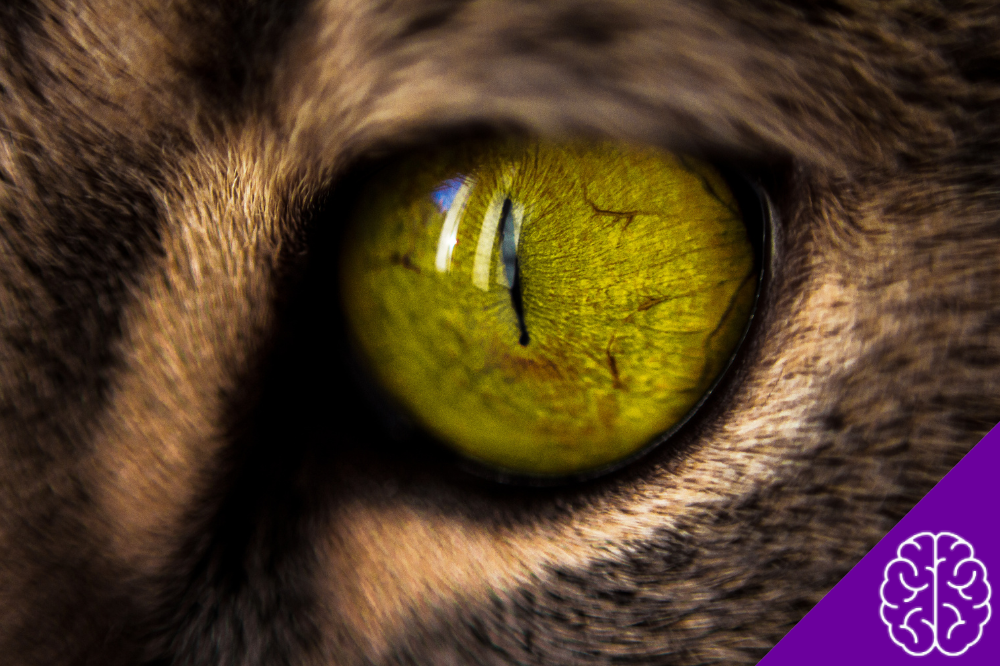
Human eyes reveal only part of the information available in nature. Animal vision varies widely across species, allowing some animals to detect light patterns, colors, or movement that humans cannot perceive in the same way.
These seven examples explore how different visual systems help animals find food, avoid predators, and navigate their surroundings. Each adaptation offers a glimpse into how species experience the world.
1. Dogs See Colors Differently Than Humans
Dogs see colors, but they distinguish fewer color combinations than humans. People typically have three types of color-sensitive cone cells, while dogs have two. This difference changes how each species identifies objects.
Dogs distinguish blues and yellows more effectively than reds and greens. A red toy on green grass, for example, may offer less color contrast to a dog than it does to a person.
What helps dogs interpret their surroundings?
- Color perception: Two types of cone cells help dogs distinguish certain colors.
- Movement detection: Rod cells help them notice movement, particularly in dim conditions.
- Brightness: Differences in light and shadow provide additional visual clues.
Dogs do not see in black and white. Their eyes simply process colors differently from human eyes.
The American Kennel Club’s guide to canine color vision explains these differences in greater detail.
2. Cats See Better in Low Light
Cats have several adaptations that help them navigate dim environments. Their pupils expand to admit more light, while their retinas contain many rod cells that respond to low illumination.
Cats also have a reflective tissue layer behind the retina called the tapetum lucidum. It reflects light back through the retina, giving photoreceptor cells another opportunity to detect it. This structure also explains why cats’ eyes can appear to glow when light shines toward them.
These features help cats detect movement during dawn, dusk, and other low-light conditions. However, cats cannot see in complete darkness, and their sensitivity to dim light does not guarantee sharper vision in every situation.
Three important points about feline vision:
- Cats benefit from even small amounts of available light.
- Their eyes can reflect light, creating a noticeable glow.
- Their low-light advantage supports hunting and nighttime movement.
The Cornell Feline Health Center provides further information about feline vision and eye health.
3. Some Birds Can See Ultraviolet Light
Humans see a limited portion of the electromagnetic spectrum. Some birds can also detect ultraviolet (UV) wavelengths, revealing patterns that remain invisible to people under ordinary lighting.
These patterns can help birds recognize potential mates, identify food, and interpret signals from other members of their species. Feathers that appear uniform to humans may contain UV-reflective markings that provide additional information to birds.
Why does ultraviolet perception matter?
- It can reveal differences in plumage that humans cannot see unaided.
- It adds visual information that birds may use during courtship.
- It can help certain species distinguish objects in their environment.
Not all birds share the same visual abilities, and UV sensitivity does not automatically mean that every bird sees colors more vividly than humans.
Research discussed by the Queensland Brain Institute explores how animals use visual information to interact with their surroundings.
4. Bees Use Ultraviolet Patterns to Find Flowers
Bees also detect ultraviolet light, which helps them locate flowers and gather information about potential food sources. Some petals reflect UV wavelengths in patterns that guide pollinators toward areas where nectar and pollen may be available.
These markings, often called nectar guides, can create contrasts that humans cannot see without specialized equipment. A flower that looks evenly colored to a person may display a distinctive pattern to a bee.
How this ability supports pollination:
- Bees use visual cues to locate flowers.
- Floral patterns can help guide them toward useful resources.
- As bees visit flowers, they may transfer pollen between plants.
Bees combine visual signals with scent and other sensory information rather than relying on color alone. This combination helps them find resources while supporting the reproduction of many flowering plants.
Although birds and bees both detect UV wavelengths, their visual systems serve different purposes. The patterns that help a bird interpret plumage are not the same as the floral cues that help a bee forage.
5. Mantis Shrimp Detect Polarized Light
Mantis shrimp have unusually complex eyes that detect several properties of light. Depending on the species, these include a broad range of wavelengths and polarized light, which has a particular orientation in its wave pattern.
Humans can experience the effects of linear polarization through specialized sunglasses. Mantis shrimp detect polarized light through their visual systems, and some species can also distinguish circularly polarized light.
Scientists continue to investigate how these abilities support communication and other behaviors. Researchers have also discovered that complex eyes do not necessarily produce better color discrimination.
A 2014 study published in Science found that mantis shrimp with 12 types of color photoreceptors performed surprisingly poorly at distinguishing closely spaced colors compared with humans. The researchers proposed that these animals process color differently rather than simply outperforming humans.
What makes their eyes unusual?
- They can detect certain properties of polarized light.
- Some species have 12 types of color photoreceptors.
- Their color-processing system differs from the conventional human model.
Read the study “A Different Form of Color Vision in Mantis Shrimp” through PubMed. This research illustrates why animal vision cannot be ranked by counting photoreceptor types alone.
6. Some Snakes Detect Heat From Prey
Certain snakes, including pit vipers, pythons, and boas, have specialized organs that detect infrared radiation emitted by warm objects. This ability provides information about temperature that ordinary human vision cannot capture.
Pit vipers have heat-sensitive pits near their nostrils, while pythons and boas have specialized pits around their mouths. These organs respond to thermal radiation and send signals to the nervous system.
The brain can combine this information with visual input to help a snake locate warm-bodied prey. This adaptation can be especially useful when visible light offers limited guidance.
Heat detection helps certain snakes:
- Locate warm-bodied animals.
- Track prey using thermal information.
- Combine temperature signals with other sensory input.
This ability is not identical to seeing the colorful images produced by a thermal camera. Instead, heat detection provides another source of information about the surrounding environment.
A study available through the National Institutes of Health’s PubMed Central examines the biological mechanisms behind infrared detection in snakes.
7. Flies Process Movement Rapidly
Flies can react to approaching threats with impressive speed. Their visual systems detect changes in the surrounding scene, helping them adjust their flight and avoid obstacles.
Unlike human eyes, a fly’s compound eyes contain numerous small visual units that sample light from different directions. Neural circuits process these signals to help the insect track motion and maintain control while flying.
Their visual systems support several tasks:
- Detecting approaching objects.
- Estimating the direction of movement.
- Adjusting flight in response to changes in the environment.
Fast motion processing does not mean flies have sharper vision in every respect. Their eyes and neural circuits prioritize rapid visual changes, while humans rely on different combinations of visual detail, color, and depth perception.
Scientists study flies to understand how nervous systems transform visual signals into behavior. The review “How Flies See Motion”, published in Annual Review of Neuroscience, examines the neural mechanisms behind this ability.
What These Visual Differences Reveal
From dogs that distinguish colors differently to snakes that detect infrared radiation, each species gathers information according to its biological needs. Some animals benefit from low-light sensitivity, while others use ultraviolet patterns, polarized light, or rapid motion detection.
These examples show that animal vision does not follow a single hierarchy of abilities. Evolution has shaped different visual systems for different environments, behaviors, and survival challenges. Studying them helps researchers understand perception and reveals how much of the natural world remains beyond ordinary human sight.
- You May Also Like: 5 Animals That Can Regrow Lost Body Parts