

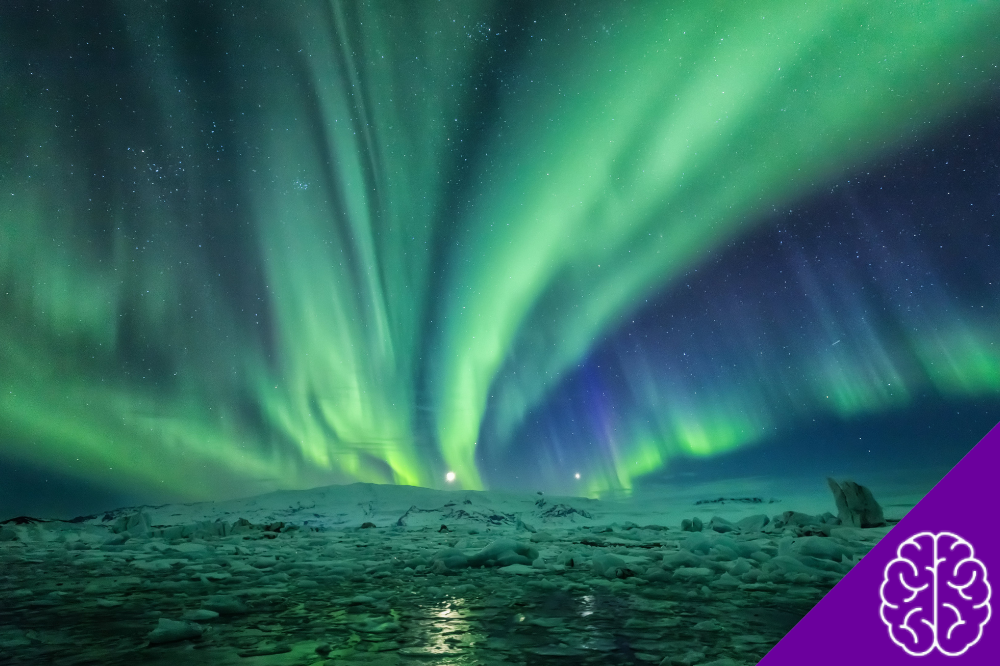
The Northern Lights can shift from faint green arcs to bright curtains of red, purple and pink. Their appearance depends on what is happening between the Sun, Earth’s magnetic field and the gases high above the planet.
Understanding those interactions also explains why auroras are concentrated near the poles, why they can suddenly become visible farther south and why their colors vary.
What Are the Northern Lights?
The Northern Lights, or aurora borealis, are the auroras observed in the Northern Hemisphere.
Auroras also occur in the Southern Hemisphere, where they are called the aurora australis, or Southern Lights.
They occur when energetic particles reach Earth’s upper atmosphere and transfer energy to atmospheric atoms and molecules. As those particles return to lower-energy states, they release photons that we see as light.
What Causes the Northern Lights?
The process starts with the Sun.
The Sun constantly releases charged particles through the solar wind. When this stream interacts with Earth’s magnetic field, energy can be transferred into the magnetosphere. Some of the resulting energetic particles are directed along magnetic field lines toward the polar regions.
When the particles enter the upper atmosphere, they collide with oxygen and nitrogen.
Those collisions excite the atmospheric gases. As the gases return to lower-energy states, they release light.
That is the basic process behind an aurora.
Why Do the Northern Lights Have Different Colors?
The color depends mainly on which atmospheric gas is involved and where the emission occurs.
The main colors include:
- Green: oxygen
- Red: oxygen
- Blue: nitrogen
- Pink: nitrogen
Different energy states and altitudes produce different emissions, so a single aurora can contain several colors simultaneously.
Green
Green is the color most commonly associated with the Northern Lights.
It comes from excited atomic oxygen and is commonly produced around 100 to 200 kilometers above Earth’s surface. The characteristic green emission has a wavelength of about 557.7 nanometers.
Red
Red also comes from oxygen, but it generally originates higher in the atmosphere.
NOAA notes that the red oxygen emission is restricted to altitudes above about 300 kilometers because of the long lifetime of the excited state responsible for that emission.
Blue and purple
Nitrogen contributes blue and purple tones.
These emissions tend to occur at lower parts of an auroral display, where energetic particles interact with nitrogen in the atmosphere.
Pink
Pink can appear along the lower edge of an aurora.
It is associated with nitrogen emissions at lower altitudes and can become especially noticeable during active displays.
Why Is Green the Most Common Color?
Green is particularly common because of the way excited oxygen emits light in the upper atmosphere.
The strongest and most recognizable green emission occurs around 557.7 nanometers, a wavelength that is readily visible to human observers.
The altitude where this emission occurs also helps distinguish it from the red oxygen emission found higher up.
How Does Altitude Affect the Colors?
Altitude is important because excited atoms and molecules do not all behave the same way.
Some excited states release their energy quickly. Others remain excited for much longer.
At lower altitudes, atmospheric particles are more densely packed, increasing the chance of collisions that can interrupt an excited state’s ability to emit its characteristic light.
This helps explain the general pattern:
- Higher altitudes: red oxygen emissions
- Around 100–200 km: green oxygen emissions are common
- Lower auroral regions: nitrogen can produce blue and pink emissions
These categories overlap, so real auroras can show several colors simultaneously.
Why Do the Northern Lights Appear Near the Poles?
Earth’s magnetic field determines where many of the particles involved in auroras travel.
Charged particles can follow magnetic field lines toward the magnetic poles, creating an auroral oval around each one.
That is why the Northern Lights are most commonly seen at high northern latitudes.
The oval is not fixed in one position. Its size and location change with geomagnetic activity.
Can the Northern Lights Be Seen Farther South?
Yes. During periods of strong geomagnetic activity, the auroral oval can expand toward lower latitudes.
This can make the Northern Lights visible in places that rarely see them. NOAA describes the auroral oval as expanding toward both higher and lower latitudes during periods of increased activity.
Visibility from a specific location also depends on darkness, cloud cover and other viewing conditions.
What Role Do Solar Storms Play?
Solar storms can make auroras more intense and widespread.
One important source is a coronal mass ejection (CME), which can send a large amount of magnetized plasma from the Sun toward Earth. When that disturbance interacts with Earth’s magnetosphere, it can increase geomagnetic activity and intensify auroras.
But a major CME is not required for every aurora.
The solar wind is continuously interacting with Earth’s magnetic environment, so auroral activity can occur under less extreme conditions as well.
Why Do the Northern Lights Move?
Auroras can appear to ripple, pulse or stretch into long arcs and curtains.
Their changing shapes reflect variations in the movement and energy of charged particles within Earth’s magnetosphere and upper atmosphere.
NOAA describes auroras in forms including:
- arcs;
- rays;
- curtains;
- patches;
- veils.
The patterns can change quickly as the surrounding space environment changes.
Can the Human Eye See All the Colors?
Not always. A faint aurora may appear mostly grayish or pale to the human eye, particularly in very dark conditions.
Our eyes become less sensitive to color in low light. Cameras can therefore capture stronger colors than a person perceives while watching the same display.
NOAA notes that modern digital cameras can detect auroral light and colors when the display is too dim for human observers to distinguish them clearly.
Are the Northern Lights Dangerous?
The auroral light itself is not dangerous to people on the ground.
The phenomenon occurs high in Earth’s atmosphere, but strong geomagnetic activity can have effects on technology.
Significant space-weather events can interfere with systems such as satellites, radio communications and electrical infrastructure. The aurora is therefore a visible consequence of space-weather activity, rather than the cause of those technological effects.
Northern Lights vs. Airglow
Auroras and airglow can look similar in photographs, but they are produced differently.
Airglow is a faint atmospheric light produced by chemical and photochemical processes and occurs around Earth continuously.
Auroras, by contrast, are linked to energetic particles and the interaction between solar energy and Earth’s magnetic field.
The two phenomena can even appear in the same nighttime images.
What Determines How an Aurora Looks?
Several factors influence the final appearance:
Solar activity: affects the amount of energy entering Earth’s magnetosphere.
Magnetic conditions: influence where particles are directed and how auroral activity develops.
Particle energy: affects how deeply particles penetrate the atmosphere.
Atmospheric composition: determines which gases can emit light.
Altitude: influences which emissions are able to occur.
That combination is why no two auroral displays have exactly the same appearance.
The Science Behind the Northern Lights
The Northern Lights are the result of a chain of events that connects the Sun to Earth’s upper atmosphere.
The solar wind interacts with Earth’s magnetic field. Energetic particles are directed toward the polar regions, where they collide with atmospheric gases. Oxygen and nitrogen then release energy as visible light.
The colors provide another clue about what is happening: oxygen produces the familiar green and red emissions, while nitrogen contributes blue and pink tones. Their altitude and energy states determine which colors become visible.